Showing posts with label W.L: Vive La France. Show all posts

Wednesday, May 16, 2012

Sacré Bleu by Christopher Moore


Rating: 3 & 1/2 Stars


Perhaps not everyone will be regaled by the rough misogyny and the superfluity of raunchy humor that's so pervasive in Christopher Moore's Sacré Bleu. The book does offer other compensations however.


For one, the setting is enthralling - late Nineteenth Century Paris set afire with the artistic talents of the Impressionist Painters. The major painters of the day all make at the very least a cameo appearance in the novel, and sometimes much more than a cameo. The book itself is an alluring mélange of historical fact and surreal fiction. Of the two major protagonists in the book, one is Henri Toulouse-Lautrec - the French aristocrat-artist - who zestfully immersed himself in Paris's sexy underbelly. The other is Lucien Lessard, Moore's fictitious baker turned painter. Together, the pair try to unravel the mystery of the apparent suicide of their friend, Vincent van Gogh. The clues lead them on the trail of the sinister 'Colorman', and his elusive companion.


One of the charms of this book for me was the many photos of the great artwork under discussion. That; and the author's intellectual athleticism. I enjoyed his effortless vaults from art history to Greek and Gaelic mythology; and all the better when he takes the reader along for the ride instead of floundering at the sidelines.


And while the bitch-goddess persona exercises a certain fascination on the imagination, in this context it's also a nod to that very French dictum - cherchéz la femme.

Tuesday, February 1, 2011

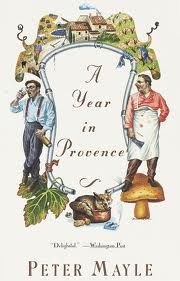
A Year in Provence by Peter Mayle


 Rating: 3 & 1/2 Stars

You cannot possibly understate the frustrations of moving to a new country, and renovating an old house - yet Peter Mayle handles the situation with grace, charm, and good humor - C'est la vie. In the late 80's, Mayle and his wife left the rainy shores of England to settle down in the Luberon region of Provence in France. Provence is a famously sunny land, but they happened to land in the midst of an unseasonably cold winter, and faced the full wrath of the Mistral, the Northerly wind that visits parts of Southern France with a vengeance:

"...We had heard stories about the Mistral. It drove people, and animals, mad. It was an extenuating circumstance in crimes of violence. It blew for fifteen days on end, uprooting trees, overturning cars, smashing windows, tossing old ladies into the gutter, splintering telegraph poles, moaning through houses like a cold and baleful ghost, causing la grippe, domestic squabbles, absenteeism from work, toothache, migraine - every problem in Provence that couldn't be blamed on the politicians was the work of the sacre vent which the Provencaux spoke about with a kind of masochistic pride."

Though he does wax rhapsodic about the food, there is more to Mayle's love of Provence than the gushing admiration of tourists bent on picturesque scenery and epicurean delights. He doesn't sugarcoat the frustrations of provincial life that one has to face when actually living there, as opposed to a brief stop in the itinerary. He recounts not just the experience of settling down into their new home, but also the process of getting to know their new neighbors, and the various colorful local personalities.

Reading Mayle's book would almost convince us that the stereotypes of France are not stereotypes after all, just the truth - whether it is the famous Gallic disdain of government, the frenetic driving style of French motorists, or, the serious physicality involved in greeting acquaintances, let alone friends.

"...It's hardly surprising that aerobics never became popular in Provence. People get quite enough physical exercise in the course of a ten-minute chat."

He does make a nice distinction between the Provencaux vis-a-vis Parisians; the latter are portrayed as far more fussy and fastidious than the former, who believe in living life with uninhibited gusto. There is an entertaining account of a dinner watching fashionable Parisian guests boogie into the night, and excusing themselves early to catch a goat-race the next morning.

Travelogues about France are plentiful. What was most engaging about this particular one was its refreshing sense of humor. There is not the slightest disdain of his host country or his eccentric neighbors, just a warm appreciation of the oddities and uniqueness, and a gratitude for all the bounty that sunshine brings.


Tuesday, January 25, 2011

The Elegance of the Hedgehog by Muriel Barbery


Rating: 3 Stars

[Translated from the French by Alison Anderson]

“With the exception of love, friendship and the beauty of Art, I don’t see much else that can nurture human life.”

This declaration is made by Paloma, one of the protagonists of Muriel Barbery’s novel, translated from the original French by Alison Anderson.  Paloma is not alone in her thought; Renee Michel shares her feelings as well. Paloma and Renee make an odd couple. Whereas Paloma is the precocious twelve-year old daughter of the well-pedigreed, excruciatingly educated, and affluent Josse family, Renee is the fifty-four year old concierge of the apartment complex they live in. 

Barely acquainted with each other, they are almost mirror images in other ways. Renee hides her voracious intelligence behind a surly, semi-literate façade, and Paloma remains brooding, mostly alone, over the shortcomings of her family and the Parisian haut monde that is their social circle. In fact, Paloma has had enough of snobs and hypocrites – that’s why she has decided to commit suicide on her thirteenth birthday. Having made peace with that choice, her interim goal is to have as many profound thoughts as possible expressed in the form of haiku.

That is one of the other things Paloma and Renee have in common: a love of Japanese culture. They’re not merely intellectuals; they’re aesthetes. Their interior monologues are disquisitions on the essence of Art, Literature, Music, Nature, and Philosophy.

Underneath their prickly armor, Renee and Paloma conceal both an unexpected caring and integrity. Ms. Barbery has created an especially exquisite character in Paloma, an ennui-ridden child who calls it as she sees it, and she sees a lot. Paloma skirts the dangers of being a poseur by virtue of her unflinching, lacerating honesty. Once she resolves to appreciate the positive, we see her awakening ever more profoundly to the beauty all around her.  
 
The one distracting thing, and yes, it is a major distraction, is the tendency to indulge in endless specious arguments that leaves the reader glassy-eyed and befogged. Here is one such gem:

When we say “a table”, when we utter the word “table”, when we make the concept of the table, are we still designating this table or are we truly referring to a universal table entity that establishes the reality of all the particular tables that exist? Is the idea of the table real, or does it merely belong to the mind?

Really? Does furniture merit so much strenuous thought? All this sophistry sounds damningly like the very thing that both Renee and Paloma purport to despise – the pretentious vanity and empty ratiocination that characterizes intellectuals. 

A fact that often escapes the clever, but is never forgotten by the wise is that whereas intelligence is a tool to be used and enjoyed, Life is a gift to be loved and cherished. In its most lucid moments, Barbery’s book reveals this awareness that under the pettiness, sham and absurdity, Life throbs in ineffable loveliness, and Art in all its forms merely captures these intimations of beauty.

Thursday, April 15, 2010

Chocolat by Joanne Harris


The way to Hell is paved with slabs of chocolate according to Father Francis Reynaud, the priest of Lansquenet-sous-Tannes, the tiny French village that is the setting for Joanne Harris’s charming novel, ‘Chocolat’.

Reynaud, wrestling with his own inner demons, is ill equipped to lead anyone else away from the slippery slopes of temptation and sin, a fact that he seems oblivious to. He watches with impotent rage as his hitherto obedient parish flock to the new chocolaterie, opened by the mysterious Vianne Rocher. He decides that drastic steps must be taken to stem this flow towards decadence, but will his measures work?

‘Chocolat’ pits unbending religious fanaticism against the allure of chocolate, and all it represents – sensuality, freedom from self-imposed inhibitions, and simple happiness.

Vianne’s non-judgmental acceptance of people’s foibles, her accommodation of an eclectic array of beliefs, and lack of adherence to social conventions, or calcifying religious convictions, puts her at odds with Reynaud - intolerant of human weaknesses, while at the same time, weighed down by his own guilty secrets, and imploding with repressed desires.

Ms. Harris takes a few well-aimed zingers against the Catholic Church, but in her over-zealous criticism, one can’t help wondering if she’ll throw the baby out with the bath water.

Though the pace is a little slow, and the plot leaves some loose ends untied, her narrative style is truly mouth-watering. Reynaud seems better depicted than the character Vianne, who never really springs off the page with the same degree of intensity. Occasionally, the humor seems forced, but the final chapters culminate in a wickedly delightful dénouement. We can’t help but applaud when hypocrisy and intolerance so effectively prove to be their own undoing.

It’s a bittersweet truth that it’s difficult to wage a victorious war against chocolate. Many dieters have learned this to their anguish. But still, I can’t help but feel for Father Reynaud in his predicament. How can people gorge so recklessly on chocolate, even if it is darker than the Devil’s deeds, with no fear of the natural consequences – Cavities! Acne! Obesity!

After all, mindless indulgence, in anything, comes at a price. By failing to explore this, the author has lost an opportunity to make a good book better.