Showing posts with label Humor. Show all posts

Monday, July 16, 2018

Lincoln in the Bardo by George Saunders


Rating: 4 Stars

2017 Booker Prize

When I first heard of this book it vaguely struck me as something unsavory, and I felt a stab of indignation on behalf of the 16th President. Hadn’t the poor man done enough; hadn’t he suffered enough? I calmed down after realizing my brain-fumble – not Lincoln in the Bordello; it was ‘Lincoln in the Bardo’. Duh.

In Tibetan Buddhism, bardo is the intermediate stage between life and death. The author conceived the idea for this novel when he learned that President Lincoln had paid several visits to a crypt in Georgetown, to hold the body of his recently deceased son. The story revolves around the untimely demise of twelve year old Willy Lincoln and the transitional phase of the boy’s bewildered spirit – uncertain as to whether he should stay behind with his father or move on to whatever realm of being awaits him.

The book is a quirky amalgam of actual historical documents, ingenious creative elements, and, word-crafting. While some of his literary experiments seem a little labored, others work very successfully. The writer deals gently with the grieving president in anguish over the loss of his child. The Lincoln we see here is the Lincoln vindicated by history and immortalized in popular culture – a very human man under extraordinary circumstances, shouldering an immense burden to the best of his abilities.

Considering that the subject is both moving and macabre, there is a surprising amount of humor here. The levity comes from the host of wraiths who are malingering in the cemetery, believing that this denial of the obvious shows their strength of character. These shades are a boisterous, bawdy, and, talkative bunch. They have a lot to get off their chest, and they think they have many reasons to hang tough. Three in particular befriend the little Lincoln and try to help him migrate to the next plane of existence because the bardo is a dangerous place for the young ones.

“…to be a child and to love one’s life enough to desire to stay here is, in this place, a terrible sin, worthy of the most severe punishment.”

The reasons for this are never made clear. Actually, the author does not give much detail, depth, or, clarity to the Great Beyond. He shies away from anything approaching actual religion, spirituality, mysticism, or, the occult. That doesn’t affect the book negatively, because oddly enough this story is more about life than death.

Wednesday, September 3, 2014

The Little World of Don Camillo by Giovanni Guareschi


[Translated from the Italian by Una Vincenzo Troubridge]

Rating: 4 Stars

It was by sheer accident that I came across this lovely little book many years ago. I found it in the small library of the small town that I was living in at that time, sorted under a note that read, ‘Librarian’s Recommendation’. I fell in love with the book, and the writer’s style all at once.

Guareschi, a WW II veteran and plyer of multiple trades, was the author and illustrator of the Don Camillo books, of which there are six. ‘The Little World of Don Camillo’ initiates the series with our introduction to the feisty priest Don Camillo, and his rival, Mayor Peppone of the Communist Party.

Less of a novel and more a connecting suite of short stories, the plot draws on the various clashes between Camillo and Peppone – be it Camillo’s refusal to baptize Peppone’s infant son with a name like ‘Lenin’; or, their feuding soccer-match; or, the ensuing ruckus when the Bishop visits their village.

Though they may lock horns in their battles to win the heart and soul of their community, these two ideological stalwarts have more in common than they want to admit. Despite his tendency to give fiery orations against the Church and its appointees, Peppone is at heart as much an Italian Catholic as anyone else in the village. Devout Don Camillo, though a man of God, is as free with administering lessons with his fists and feet, as he is with his sermons. But if the circumstances call for it, they will work together for their excitable and boisterous flock/compatriots.

This underlying conviction, that men of good intentions can, and will, put aside their differences for the greater good is the essence of the book – one of the reasons for its charm, that, and the benevolent take on humanity as evinced by Camillo’s confidante, the receptor of all his musings – the conversational Christ, who looks on with an equally tolerant eye on Camillo and Peppone alike.


Tuesday, April 2, 2013

Just Enough Jeeves by P.G. Wodehouse


Rating: 3 & ½ Stars

Wodehouse’s name is synonymous with a certain kind of British humor – the one that’s as light and airy as a soufflé. In a literary career that spanned nearly seventy years, much of his writing is set in the Edwardian era. His countrymen have him to thank for the persistent stereotypes of Englishmen who sport monocles, knickerbockers, and say things like ‘pip pip’, ‘Cheerio’, and ‘toodles’. The rest of us are bemused and charmed by a people in the thrall of harmless if eccentric notions of fealty, royalty, and afternoon tea.

Wodehouse’s most enduring creation is the pairing of that feather-headed man-about-town, Bertram Wooster, and his brilliant valet, Jeeves. ‘Just Enough Jeeves’ is a collection of two novels – Joy in the Morning and Right Ho, Jeeves and an anthology of short stories – Very Good, Jeeves!

Those who are familiar with the Jeeves series know that Bertie is less the silly nincompoop that his friends and family take him for and more the innocent scapegoat who keeps landing in the wrong place at the wrong time. Kind and chivalrous to a fault, he invariably finds himself fending off over-bearing aunts and girls with the predatory glint of matrimonial intentions in their eyes. The latter convince themselves that he’s languishing in love of them when nothing could be further from the truth, but Wooster is too much of a gentleman to set them straight. When he’s not trying to disentangle himself from their clutches, he’s either complicating or endeavoring to smooth out the love life of his various humorously named friends – Bingo Little, Boko Fittleworth, Tuppy Glossop, or Gussie Fink-Nottle.

Deftly steering him through these difficulties to the guaranteed happy endings is his gentleman’s gentleman – Jeeves. A prodigious reader and insightful student of human nature, Jeeves plies his perspicacity in the aid of ‘the young master’. It is not all in the feudal spirit however. Bertie frequently pays the price for these services in the form of various small sacrifices – whether it’s in the reluctant relinquishing of some sartorial whim, or last minute change of plans, or having his eyes abruptly opened to the unsuitability of someone he has a crush on. Jeeves always has the last say.

Wednesday, May 30, 2012

Cold Comfort Farm by Stella Gibbons


Rating: 3 Stars

Published in 1932, Gibbons’ Cold Comfort Farm is one of those farces that run rife with quirky characters and madcap antics. It’s an undemanding read for a rainy afternoon; once you look past the tortured metaphors, and the overly bright, brittle humor that characterizes so many British books of that period.

Flora Poste is a recently (nearly) impoverished young woman, who, scorning advice to support herself by earning her way through life, decides instead to accept the hospitality of relations with whom she’s barely acquainted. Brimming with good intentions, good taste, and good sense, she descends on Cold Comfort Farm and immediately sets to matchmaking, meddling, and reforming her socially maladjusted kin – the Starkadders.

The Starkadders, each equipped with their unique set of eccentricities, are securely under the thumb of Flora’s Great Aunt Ada Doom, who has been wallowing in her own private psychosis for the past several decades. How will Auntie’s forbidding yet fragile mental condition endure the onslaught of Flora’s relentless charm and feminine insight?

If the plot sounds vaguely familiar to some of you, it should; Gibbons is patently channeling Jane Austen’s Emma. While her literary influences are quite evident, it’s not a good idea to try to combine the style and sensibility of both Austen and Emily Brontë in a single book – simply put, the twain shall never meet. However it’s not just that.

The comedy and deft characterization in Emma stem partly from the fact that the heroine consistently misreads people and situations, and embroils herself in one mortifying scenario after another. The Emma we see at the book’s end has had her ‘she-woman and mistress of the universe’ self-image slightly deflated. In the process, she has grown in both self-awareness and humility, thereby becoming much more likeable. Flora, on the other hand, undergoes no such enlightening experiences. None of her plans go awry, and she’s very clearly a superior being conferring her favors on lesser mortals. That makes a huge difference to the tone of a book.

Wednesday, February 8, 2012

Pride and Prejudice by Jane Austen


Rating: 4 Stars
“It is a truth universally acknowledged that a single man in possession of a good fortune must be in want of a wife.”
Rarely has any other opening line to a book been as synecdochic as Jane Austen’s commencement of Pride and Prejudice. Those few words succinctly capture the essence of the work – elegance, wit, satire, matrimony, and mercenary concerns. Austen merely reiterates a general cliché – which is, that a fat bank balance is to female fantasy as a bountiful bosom is to male fantasy. Either scenario unleashes the human imagination and lets it run amok with possibilities for gratification.
The world of romance fiction diverges greatly from the real world where attraction has been known to spark between the unlikeliest couples. Elizabeth Bennet and Fitzwilliam Darcy are a very likely couple, at least to those who have read romances. Their chemistry is akin to the immoveable object coming face to face with the irresistible force. Though she tries to laugh it off, Elizabeth’s nose is set out of joint when Darcy snubs her at their initial meeting. He soon regrets the inauspicious start of their relationship, but being gifted with abundant self-confidence doesn’t let it deter him. This soon leads to the most famously insulting proposal in Literature, guaranteed to have the recipient’s heart boiling over with indignation.
There is nothing out of the ordinary about the plot – romantic complications, family entanglements, and social considerations. These are narrated without either melodrama or dour realism. Confining itself materially to the domestic life of young women of a marriageable age, yet it is written with such verve and incandescent humor that each reading is at least as enjoyable as the first. The society depicted is a hot-house – gentlemen of leisure who seem to have nothing better to do than attend balls, pay court to gaggles of young ladies, read, shoot, and give parties. Likewise, the women have a scandalous amount of free time to devote to clothes, gaiety, and thoughts of marriage. When all else fails to entertain, there is that perennial favorite of small-minded people living in in a small world –discussing the deficiencies of their acquaintances. On the plus side, this gives free rein to Austen’s skillful characterization and the ironic observations that make this book almost as much a comedy of manners as it is a romance.
There are many reasons why Pride and Prejudice will still be left standing, when so many other books have been consigned to the recycling bins, but it has its flaws. Keeping in mind that the book was published in 1813, the conversational language between the characters still strikes one as brittle and artificial. Surely, no one talked this way. While Mr. Darcy is perhaps the best example of a hero in Romantic fiction, Elizabeth is admirable for her lively intelligence and independent mind; but you could say that she loved wisely rather than too well. Though the pair is the epitome of civilized attraction, what is romance without passion? But no, that won’t do; in the universe of Austen, that might be…imprudent. Where then do we go for a literary classic that shows love in its more unruly aspects? That, my friends, will be another book, another post, another day.

Wednesday, December 28, 2011

Three Men in a Boat by Jerome K. Jerome


Rating: 3 Stars
This 19th century book is still considered a classic of English humor. If the lists are to be believed, according to many Brits, it is among the funniest books of all time.
It’s a fictionalized version of a boat-trip honeymoon down the Thames that the author had made with his wife. In the book, the Narrator, ‘J’, given to chronic hypochondria and his two friends – William Harris and George - decide that that a vacation is just what they need to offset their ennui. Packing what they consider the bare essentials, along with a rambunctious fox terrier, they head off for a fortnight of sight-seeing, roughing it, and mild adventure.
The humor of the book is gentle, free of hard edges – which would perhaps explain its appeal. Jerome’s whimsical observations on human foibles ring true and funny even to this day, as for example, when he wryly remarks about his friend,
“That’s Harris all over – so ready to take the burden of everything himself, and put it on the backs of other people.”
One of my favorites was the amusing chapter on fish(y) tales. It just goes to show that the ‘whoppers’ the anglers bragged about landing, are nowhere as big as the whoppers they told.
The book also reads as a breezy English travelogue of the age with enough asides to interest the amateur historian. Jerome’s tone is conversational, and he frequently goes off tangent, taking the scenic route before he gets to a point, but then that’s part of its charm.


Wednesday, November 2, 2011

My Family and Other Animals by Gerald Durrell


Rating: 4 Stars

Book Club November 2011 Pick

The literary universe offers endless possibilities for those of us with a critical bent of mind; predisposed to entertain ourselves with the analysis, assessment, and evaluation of books. There are however times when we have to admit defeat. There are some books that we have read too often, loved too well, and enjoyed too much to the extent that our perspective is hopelessly compromised. Those are the times when we shut the door on that opinionated little inner voice, and surrender ourselves to the enchantment of being transported to another world, where plot conventions have no more meaning than stylistic devices. Thank God for those occasions, and how I wish there were more of them.
Published in 1956, ‘My Family and Other Animals’ is an affectionate chronicle of the adolescent years that Durrell spent on the Greek island of Corfu with his eccentric and always entertaining family. The venturesome Durrells emigrate to Greece in the 1930’s in search of some balmy weather, and literary inspiration. The move is instigated by Larry, the eldest in the family. Lawrence Durrell (who later gained literary fame with works like his Alexandria quartet) is portrayed as a provocative gadfly of a personality – brilliant, caustic, and witty. Rounding off the rest of the family is the widowed Mrs. Durrell, and Gerald Durrell’s two other siblings – Leslie and Margo. Each character is endowed with their own peculiarities that are depicted with great relish. Fans of Gerald Durrell’s style of humor will savor this unconventional family’s quirks, and their assortment of equally colorful friends.
“…It was originally intended to be a mildly nostalgic account of the natural history of the island, but I made a grave mistake by introducing my family into the book in the first few chapters…by exercising considerable cunning…I managed to retain a few pages here and there which I could devote exclusively to animals.”
Gerald Durrell went on to become both a popular writer, and a renowned zoologist and conservationist. This book gives us a glimpse into the early propensities that made these dual careers as natural as they were inevitable.
Whether the animals are more or less diverting than the humans populating the narrative is a moot point. What colors the humor of the memoir, and lends it its irrepressible joie de vivre is the appreciation of individuality wherever it is found; and apparently it is found everywhere. What is also found in abundance is that other precious commodity – beauty. When Durrell is not delighting with his exuberant, over-the-top humor, he beguiles with writing that never fails to drown me in its loveliness, no matter how often I read this book. Whether it’s the breathtaking verve in his tale of an encounter between a gecko and a mantis that is recounted as a battle of epic proportions; or, descriptions of sumptuous family picnics and get-togethers, the details are rendered in stunningly exquisite prose.
The memoir, as I’ve said elsewhere in this blog is the most slippery of nonfiction genres. The successful memoirist engages his audience’s interest by playing a wily game of revelation and concealment, as enticing and illusive as any fan dance. This book is no different in that respect. Ultimately, the reasons I love My Family and Other Animals are complicated and deeply personal. Suffice it to say that, every time I lose myself between its covers, I rediscover with a sense of wonder and grateful relief, that what delighted once delights still. The dearest books have this in common with the dearest friends…we outgrow neither.

Thursday, July 28, 2011

The Adventures of Huckleberry Finn by Mark Twain


Rating: 4 Stars

‘The Adventures of Huckleberry Finn’ – now there’s an appropriate title. Not from Twain the post-modern magic act where the plot vanishes, and the poor reader is subjected to interminable longueur meandering through the protagonists’ rich and complex inner lives. The best novelists understand that inner and outer lives are not mutually exclusive.

The story picks up where ‘Tom Sawyer’ left off. Thanks to their dashing exploits in the first book, both boys have become local heroes, and accumulated a tidy little sum of money in the bargain. Motherless and under-parented Huck along with his disreputable father, have hitherto been mostly ignored and ostracized by the community. Now, to his misery, he finds himself clasped to the town's grateful bosom. Poor Huck; all he yearns for is to live out his vocation to be a shiftless bum. Unfortunately, the Widow Douglas is undaunted in her campaign to ‘sivilize’ and Christianize him. His troubles, however, are just starting. Once his mean father hears of his son’s windfall, he is back in his life to assert his paternal authority. Through an act of sheer inspiration, Huck escapes both his father and the fetters of society. He soon discovers someone who has even more reason to make a run for it – Jim, a fugitive slave. The two of them, on their journey down the Mississippi river encounter thieves, murderers, con men, and feuding Southern families; and all that before they can find a solution to their own problems.

Huck is an archetypal American hero – the wide-eyed naïf, who sees the world more clearly than many around him. He is an ideal narrator for a picaresque novel – his dispassionate account of no-good scoundrels and his deadpan observations are the author’s ironic commentary on his times. Twain mines a seemingly inexhaustible vein of humor that makes light of the values and lifestyle of the South. One of my favorites, for example, was when the feuding Grangerfords and Shepherdsons attend church, toting guns while the sermon goes on endlessly about brotherhood, and ‘such-like foolishness’. This inspires his hosts to prattle about so many virtuous and noble topics that the beleaguered Huck confesses that it was ‘one of the roughest Sundays I had run across yet’.

There are points where the narrative takes a dark turn. Despite Twain’s rollicking sense of humor, this is not a book that has the all-embracing good will of say, To Kill A Mockingbird. There are many occasions where we see human nature at its worst, and there is a savagery to the satire. In Twain’s world, it’s not just about the vicious preying on the innocent. Cupidity thrives when it meets stupidity - that’s the unattractive truth. It’s easy to detect that Twain is amused rather than outraged by rogues, and in his view, it’s not people’s eagerness to exploit one another that is scandalous. Rather, the real tragedy as Huck sadly observes is that,

 "Human beings can be awful cruel to one another."
 
Twain’s use of the common vernacular and his stringent humor did not win him universal popularity. This flagship work of American Literature remains to date one of the most challenged books in the U.S., and the fourth most banned in American schools. On hearing that the public library of Concord, Massachussets had banned ‘Huckleberry Finn’, Twain wrote an ironic letter thanking them for boosting sales. More evidence that censorship doesn’t work – never has, never will.

Which is not to say that the objections are unfounded; this is one book that is as controversial as it is beloved, as flawed as it is great. One of the charges against it is racism. The pejorative term for people of African origin, 'n.....’ appears a staggering 219 times from first chapter to last. Twain’s views on race are complicated, to say the least. On the other hand, his feelings about slavery are unequivocal. It may be interpreted that Huck’s journey down the Mississippi is a metaphor for the transformation he undergoes in his feelings towards Jim, who becomes more than a runaway slave, rather a dear friend whose life and freedom are of vital importance to him.

When it comes to technique, Twain is not one of those meticulous-minded authors who dot the ‘i’s and cross the ‘t’s. His paints gloriously, messily, with a child’s abandon. Persnickety critics may find fault, and yes, strictly speaking there are faults to be found. For example, the introduction of Tom Sawyer towards the end seems an uncalled for intrusion. Why did Twain do it? Perhaps, because he felt, like many readers, that that irrepressible rascal, as much as he unnecessarily complicates things, also makes them more fun. Or perhaps, to him the  boys were inseparable, two sides of the same coin. As one critic perspicaciously observed, ‘Tom Sawyer was who Twain was; Huckleberry Finn was who he wanted to be.’

Thursday, July 7, 2011

Manhood for Amateurs by Michael Chabon


Rating: 3 Stars

In some ways, Chabon’s essays are the antithesis of the qualities lauded in Rudyard Kipling’s celebrated poem on manhood – ‘If’. Man, not as a compendium of noble ideals, but rather as an occasional loser, screw-up, and jerk. It should probably be added that Chabon's mostly talking of himself rather than anyone else.

At his best, as in ‘Getting Out’, his writing is lucid, sensitive and subtle. In others, he simply misses the mark, rambling aimlessly, taking the reader on a trip that has us whining, ‘Are we there yet?’ One or two come off as rants, as in ‘The Splendors of Crap’. Sure, the entertainment peddled to our kids is often inane, treacly, or deplorable. But here’s the thing - the kids lap up this sludge. If parents want to influence their children's tastes, that’s best achieved by getting involved and staying actively engaged in their recreational pursuits.

Chabon also riffs with varying degrees of persuasion on other time-honored ‘manly’ isues – carpentry involving power tools, brotherly bonds, baseball, comics, and science fiction T.V. shows. There are a couple where he self-consciously sets himself apart from the rest of his tribe, as in his stated indifference to public opinion when it comes to carrying a 'man-purse', his protest at gender-assigned colors, and his pride in his cooking abilities. Here again, America is a step behind the rest of the world. As I see it, men the world over do not feel their masculinity challenged merely by wearing pink or violet, having a handy tote, or at feeling at home in the kitchen.

Having weathered a difficult and fractured childhood, Chabon seems to bear commendably little hostility towards his own parents. He doesn’t seem to hold it against them that they divorced; split siblings apart; either faded away from his life; or, busied themselves in pursuing the lifestyles of the Groovy 60’s and Swinging 70’s.

Books are meant to be critiqued; courtesy and self-doubt should restrain us from doing the same to the parenting techniques of other adults. Except of course, in those cases, where said parents hang placards with concentric red circles around their necks and invite us to try our marksmanship, as in perhaps, writing a book about their child-management. One interesting example was the conversation that Chabon has with his four children, ranging in ages from 13 to 4, about drug use. He seems to have spent more time agonizing over the decision to circumcise his sons. 

Having chosen earlier with his wife to be completely honest and transparent about their own pharmaceutical experiments, he then proceeds to inform the kids about the enticements of getting high on marijuana, and concludes by informing them that that’s not something they’re ‘ready to do.’ How much honesty can children handle? Are their needs served better by a full confessional, or do we hold back on the whole troubling truth, respecting their innocence and (sometimes wholly unfounded) trust in the better judgment of their parents? Fools rush in where angels fear to tread.

Tuesday, March 15, 2011

The Color of Magic by Terry Pratchett


Rating: 3 Stars

Swimming gently through space is the great turtle A’Tuin . On his back stand four gigantic elephants on whose back is balanced a circular disc of a planet. Is this making sense yet? If it doesn’t, congratulations, you’ve gained entry to Discworld, where the reigning order is Chaos, and the only reliable guide is the road map to enchantment. To give you a sample of Pratchett, his theory of the Multiverse might suffice:

An alternative favored by those of a religious persuasion, was that A’Tuin was crawling from the Birthplace to the Time of Mating, as were all the stars in the sky which were, obviously also carried by giant turtles. When they arrived, they would briefly and passionately mate, for the first and only time, and from that fiery union new turtles would be born to carry a new pattern of worlds. This was known as the Big Bang hypothesis.

Though I wouldn’t rank this book with Pratchett’s  best, you couldn’t guess that it was the first of many books in the Discworld series, the reason being that there is nothing even remotely tentative about Pratchett’s writing. He dives in with aplomb, and the bemused reader is swept along in the contrails of his imagination.
‘The Color of Magic’ gives us a broad overview of the geography and nature of Discworld. The magic in this fantasy series is of a most slippery sort, not something to be tamed, but a wild and elemental force that rules all of Discworld, but is more perceptible in some areas than others. It is the kind of world where anything can happen and usually does. 

This book is loosely divided into four parts. In the first, 'The Color of Magic', we meet Twoflower and his reluctant wizard guide, Rincewind. Rincewind is a bright underachiever with a certain atavistic instinct for survival. He is our hero, for lack of a better word. In ‘The Sending of Eight’ the many gods of Discworld have some sporting fun with the hapless duo. Rincewind is unfortunate in many respects, except that he has found favor with the most powerful goddess of all, known only as the Lady, but whose last name might be Luck. In 'The Lure of the Wyrm', Rincewind and Twoflower team up with Hrun the Barbarian. In the last, 'Close to the Edge', the two fall into the clutches of the astronomers of Krull, who have come up with a device to determine the sex of A’Tuin (Well, wouldn’t you want to know?)

Though Discworld may teem with the stuff of fantasy legends – heroes, magic, dragons, beautiful women; if you’re looking for the obvious, you’ll never find it in a  Pratchett book. He doesn’t have the most accessible of styles, and is by no means easy reading. In fact, his books should come with a cautionary label, something along the lines of, Warning: An acquired taste that may flare into a full-blown addiction.

Tuesday, February 1, 2011

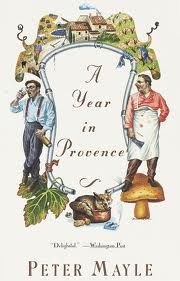
A Year in Provence by Peter Mayle


 Rating: 3 & 1/2 Stars

You cannot possibly understate the frustrations of moving to a new country, and renovating an old house - yet Peter Mayle handles the situation with grace, charm, and good humor - C'est la vie. In the late 80's, Mayle and his wife left the rainy shores of England to settle down in the Luberon region of Provence in France. Provence is a famously sunny land, but they happened to land in the midst of an unseasonably cold winter, and faced the full wrath of the Mistral, the Northerly wind that visits parts of Southern France with a vengeance:

"...We had heard stories about the Mistral. It drove people, and animals, mad. It was an extenuating circumstance in crimes of violence. It blew for fifteen days on end, uprooting trees, overturning cars, smashing windows, tossing old ladies into the gutter, splintering telegraph poles, moaning through houses like a cold and baleful ghost, causing la grippe, domestic squabbles, absenteeism from work, toothache, migraine - every problem in Provence that couldn't be blamed on the politicians was the work of the sacre vent which the Provencaux spoke about with a kind of masochistic pride."

Though he does wax rhapsodic about the food, there is more to Mayle's love of Provence than the gushing admiration of tourists bent on picturesque scenery and epicurean delights. He doesn't sugarcoat the frustrations of provincial life that one has to face when actually living there, as opposed to a brief stop in the itinerary. He recounts not just the experience of settling down into their new home, but also the process of getting to know their new neighbors, and the various colorful local personalities.

Reading Mayle's book would almost convince us that the stereotypes of France are not stereotypes after all, just the truth - whether it is the famous Gallic disdain of government, the frenetic driving style of French motorists, or, the serious physicality involved in greeting acquaintances, let alone friends.

"...It's hardly surprising that aerobics never became popular in Provence. People get quite enough physical exercise in the course of a ten-minute chat."

He does make a nice distinction between the Provencaux vis-a-vis Parisians; the latter are portrayed as far more fussy and fastidious than the former, who believe in living life with uninhibited gusto. There is an entertaining account of a dinner watching fashionable Parisian guests boogie into the night, and excusing themselves early to catch a goat-race the next morning.

Travelogues about France are plentiful. What was most engaging about this particular one was its refreshing sense of humor. There is not the slightest disdain of his host country or his eccentric neighbors, just a warm appreciation of the oddities and uniqueness, and a gratitude for all the bounty that sunshine brings.


Sunday, November 28, 2010

Major Pettigrew’s Last Stand by Helen Simonson


‘Sakhi’ Book Club Dec. 2010 Pick

In ‘Major Pettigrew’s Last Stand’, the inhabitants of Edgecombe St. Mary appear to be feeling the backlash of colonialism’s karma. They have hitherto practiced a genteel social segregation – a place for everyone and everyone in their place. But their Pakistani neighbors don’t seem to be following the rules – they’re refusing to use the service entrance at the clubhouses; questioning the traditional British perspective of the Indian sub-continent’s history; and horrors, even aspiring to hobnob with them as social equals.

The protagonist of Helen Simonson’s novel, Major Pettigrew, is himself a quintessential English gentleman, so rigid, that not only does he have a stiff upper lip, he also seems to have a very stiff poker inserted up a bodily cavity. The Major does not impress favorably at first sight. He seems to have a profound distaste for all things un-English, such as European couture, American commercialism, or even the notion of a more equitable sharing of one’s patrimony.

But a strange thing happens. Following the death of his brother, and a moment of sympathy from the local Pakistani shop-owner, Mrs. Jasmina Ali, he finds himself increasingly attracted to her. The Major and Mrs. Ali have a lot in common - both book-lovers, who are mourning the passing away of much-loved spouses, and whose family members impose shamelessly on them. They are both also very much a part of their own social world, though not averse to the other’s. Therein lies the problem. The Major’s English friends and neighbors make it plain to him that his ‘lady-friend’ could never truly be one of them. The Major, who has more than a few hypocritical bones in his body, has his doubts as well. Jasmina, hemmed in by her husband’s conservative Muslim family, has problems of her own to resolve. Will true love surmount all obstacles, or will it give in quietly to practical considerations?

The English comedy of manners is a hard act to pull off. It requires a deft, delicate touch accompanied by a spot-on skewering of society’s little hypocrisies and intolerance. Ms. Simonson has done a commendable job in this novel. Her witty, observant writing reveals that no single community holds the exclusive rights to small-mindedness and bigotry. She manages to peel away the carefully cultivated layers of national attitudes and cultural identities to reveal the imperfect, endearing human beings underneath. A promising beginning from a debutante author.

Friday, September 24, 2010

Marrying Off Mother and Other Stories by Gerald Durrell


Rating: 3 Stars

The British are famous for one kind of humor, but then there is also another, which is somewhat …less dry. Gerald Durrell’s boisterous stories are each one a rollicking madcap farce. His delight in the absurd will not be new to readers who are acquainted with his memoirs of his early years in Corfu, and his wildly unconventional and ever entertaining family.

This book, Marrying Off Mother, is (mostly) a collection of humorous stories detailing his travels, peopled by a host of oddball characters parading a dazzling array of eccentricities. Durrell’s richly colorful language invokes images dripping with vividness. Here’s his description of ‘Miz’ Magnolia –

“…like a thread of smoke clad in chiffon and scent, tinkling with jewels, fragile as a will-o’-the-wisp, blue eyes big as saucers, the delicate skin of her throat hanging down like victory banners of her successful survival.”

            Whether he’s trying to understand the intricate social order of the American South, or attempting to find the wellsprings of mirth in his earnest young German friend, Durrell’s sense of humor is always revelatory of a robust exultation in the quirks of humans, not to mention animals. His description of the truffle-hunting porker, Esmeralda, has a tenderness and detail that an Art Historian might reserve for a Renaissance Madonna.

            Like many other humorists, there is an undercurrent of tragedy in his work too. There are certainly some examples of those here; and then, there is the macabre “The Jury”, that’s startlingly reminiscent of Edgar Allan Poe.

            ‘Fact’ is a thorny issue when it comes to memoirs. There are some stories here that seem to lack first person authenticity, and some that are decidedly suspect. Could they all possibly be true? The author makes a charming disclaimer about that at the beginning of the book. After all, lying is one thing, but creatively fictionalizing the truth? Well, that’s the art of writing.

            One disadvantage that a humorist faces is that our idea of ‘funny’ changes with time. While Gerald Durrell might find feather-brained females amusing, today’s readers might be able to relate to it on the same level as Marilyn Monroe’s dumb blonde act - it’s dated. There are other wince-worthy moments too - perhaps in some distant era, one could have looked at the enabling of alcoholics, and the antics of pedophile priests with an indulgent eye. Now, we’re merely embarrassed for the writer.

            Comics are hardly ever politically correct, but in one way, Gerald Durrell was way ahead of his times. All his life, he was an animal lover; and most of his adult life, he was a zoologist and conservationist, championing the rights of “the great voteless and voiceless majority”. Much of the profits from his books went towards supporting his cause – the Durrell Wildlife Conservation Trust.