Showing posts with label Thats Classic. Show all posts

Monday, June 29, 2015

Middlemarch by George Eliot


4 Stars

It seems a little unfair that all other Victorians novelists are thrown into the gigantic shade cast by Charles Dickens. To most readers, and even non-readers, his writing captures the zeitgeist of the Victorian era like none other.

It’s interesting to note that Dickens was one of the few to instantly suspect that ‘George Eliot’ was in all probability the pseudonym of a female writer. He said as much in a fan letter to her in 1858:

“…I should have been strongly disposed, if I had been left to my own devices, to address the said writer as a woman. I have observed what seems to me to be such womanly touches, in those moving fictions, that the assurance on the title-page is insufficient to satisfy me, even now…You will not suppose that I have any vulgar wish to fathom your secret. I mention the point as one of great interest to me – not of mere curiosity.”

George Eliot did come forward later to reveal herself as Mary Ann Evans. Her initial reticence could perhaps be ascribed to many factors: her desire to shield her private life (she was co-habiting with a married man); she was already working as a journalist and editor under her own name; and, also, because apparently she wished to be judged on her own merit, not to be compared with other female writers of the age.

‘Middlemarch’ is far from being a feminist diatribe, but in its depiction of the ‘lot’ of women, Eliot’s mature understanding of gender inequality certainly has no predecessors. The protagonist, Dorothea Brooke, is no social rebel; at least not by her standards. She doesn’t defy social restrictions. Rather, she seems to be oblivious of them; choosing to live a life guided by her conscience rather than convention.

The book has intersecting plot lines and a vast cast of characters, many of them relatively important to the progress of the narrative. The title of the book refers to a fictional manufacturing town. Eliot sets the novel in the early 1830s - forty years prior to the date of its publication. Choosing that time period for the plot enables her to delve into political issues such as the passage of the Reform Act, the onset of the British railways, the death of one king and the succession of another, and the medical practices of a bygone age. Whether the book is improved by the long-winded digressions into obsolete medical procedures and petty politics; or if it even qualifies as an actual historical novel, is a subject open for debate.

She is the quintessential Victorian writer – circuitous, verbose, unable to arrive at any point without expanding on several other topics, all of which she seems to consider germane to the central issue. And, she does seem to go over-board in her anxiety that no one in the story should be ill-judged:

“Pray think no ill of Miss Noble…”
“For my part, I have some fellow-feeling with Dr. Sprague…”
“Think no evil of her (Rosamond), pray…”

Perhaps readers should be extended the courtesy of making up their own minds.

But there’s a genuine kindness that makes one excuse her fussy empathy. And of course, Eliot has many kinds of humor in her quiver – gentle, observational, ironic.

Though she spared no effort to be taken seriously, the real strength of her writing, the enduring value of her books lies in her perceptive, and yes, very feminine understanding of human nature, or as Dickens called it, the ‘womanly touches’.

“If we had a keen vision and feeling of all ordinary life, it would be like hearing the grass grow and the squirrel’s heart beat, and we should die of that roar which lies on the other side of silence. As it is, the quickest of us walk about well wadded with stupidity.”


Eliot was perhaps much less ‘wadded with stupidity’ than the vast majority of people. Her sensitive psychological insight and compassion makes her characters - every one of them - intensely real, intensely relevant for all ages.

Discussion Questions for this book at:

http://noa-betweenthelines.blogspot.com/2015/07/george-eliots-middlemarch-discussion.html

Tuesday, May 8, 2012

The Woman in White by Wilkie Collins


Rating: 4 Stars

Wilkie Collins is considered by many to be the first author of detective fiction. Trained in the law, the sleuthing techniques used in his work paved the way for Arthur Conan Doyle’s Sherlock Holmes. Collins’s 1859 novel, ‘The Woman in White’ is written in the epistolary style reflecting multiple viewpoints, with some portions seeming like outright witness statements.

Walter Hartright, a young art teacher is employed at Limmeridge House by Mr. Fairlie to restore his art-work and to teach his niece Laura Fairlie, and her half-sister Marian Halcombe. In no time at all, Walter falls in love with Laura, but takes the honorable recourse of removing his impecunious self from the scene, so that she may marry her titled fiancé. Alas, much tragedy lies in wait for Laura, a young woman exasperatingly incapable of taking any decisions on her own behalf. She leaves that to the intrepid Marian.

Danger hems in the sisters from all sides, and the key to the mystery lies with an eerie young woman whom Walter had met by chance. Damsels in distress; a noble-minded hero guided by the highest principles; unscrupulous villains; and, a plot with many twists and turns - the book is a true Victorian pot-boiler.

It is not free of the maudlin sentimentality that hounds even the best works of this period, and at times betrays an overwrought imagination that could have been dispensed with. But to the question does it work – the answer is yes. Collins keeps the threads of the narrative firmly in his possession, and the work has a contemporary charm in its sudden quirks of humor, and astute characterization, except in the case of Laura Fairlie who is presumably the Victorian ideal of a delicate-minded lady. It has the watermark of the successful mystery – it keeps you engrossed till the last page.

Tuesday, March 27, 2012

Wuthering Heights by Emily Bronte


Rating: 3 & ½ Stars


Romance is dead. I don’t mean in real life; here it manages to be as robust as ever. It can be evidenced in the scampering of squirrels as they chase each other in a dizzying roundel of playful courtship, and little old octogenarians who still hold hands. As far as the literary genre goes however, it pretty much died out more than a hundred years ago. Nowadays when a Romance isn’t self-consciously and verbosely ‘literate’, it’s running the gamut from forgettable to abysmal. It has diversified to accommodate the different tastes of an overwhelmingly female audience, and one might infer that readers’ preferences range from barons and buccaneers to firemen and Amish farmers. Of late, the list has come to include vampires, werewolves, and whatnot, to cater to those whose fond notion of eternal love is to snuggle with the undead. Even the classics have not been spared a revisionist take in this regard. Hence, we have ‘Pride and Prejudice and Zombies’ and ‘Wuthering Bites’.


‘Pride and Prejudice’ at least can be safely absolved of the current obsession for books featuring the heart-aches of pasty-faced ghouls. Let’s lay the blame for that where it belongs – ‘Wuthering Heights’ with its tempestuous wild-child heroine, Catherine Earnshaw, a woman who must have her cake and eat it too. Catherine’s soul-mate is Heathcliff, the original bad boy of romance fiction. The unholy pair wreaks havoc in each other’s lives and the lives of all around them in their demented pursuit of a love that will know no satisfaction. That is Emily Bronte’s great contribution to Literature – the demon-lover, the woman who haunts him relentlessly, and a relationship that scorns every social convention.


Do I sense anyone rolling their eyes? If you’ve read the book and either merely raised your eyebrows, or even succumbed to rapturous sighs, then the credit goes to Bronte, who pulls off a nifty feat in making an improbable relationship seem plausible. Partly, it is in her characterization: we each love in accordance with our nature, and the author leaves us in no doubt that our protagonists are two very uncommon individuals. The psyches of the main characters and the others are left open to interpretation, with the author sprinkling subtle hints to guide our inference. This, along with Bronte's canny use of Gothic elements, and the wild moors of 18th. Century Yorkshire as the background impart a weirdly compelling quality to the narrative -

"I perceive that people in these regions...live more in earnest, more in themselves and less in surface change, and frivolous external things. I could fancy a love for life here almost possible; and I was a fixed unbeliever in any love of a year's standing..."

Perhaps the time has passed for Romance in Literature, and it has simply gone the way of the Epistolary or Picaresque novel, no longer relevant or viable in the twenty-first century. The common factor for all the great Romance novels of the past were one or more of the following – nobility, restraint, or, anguish at an irreplaceable loss. But the times, they’re a-changin’. Our age of instant gratification, disposable relationships, expedited divorce and laissez-faire values seduces us with the idea that there are plenty of other fish in the sea.


Romance, on the other hand, is based on the ideal that we have one fragile chance at happiness. Like Cathy and Heathcliff find out too late, if we let that slip through our fingers, we live but a shadow of the life that we could have had. Those of us who have a distaste for hyperbole, or wildly irrational exhibitions of passion, or behavior that defies common sense should probably steer clear of this book. Those of us who believe that love is truly a magnificent obsession will find it an irresistible treat.

Wednesday, February 8, 2012

Pride and Prejudice by Jane Austen


Rating: 4 Stars
“It is a truth universally acknowledged that a single man in possession of a good fortune must be in want of a wife.”
Rarely has any other opening line to a book been as synecdochic as Jane Austen’s commencement of Pride and Prejudice. Those few words succinctly capture the essence of the work – elegance, wit, satire, matrimony, and mercenary concerns. Austen merely reiterates a general clichĂ© – which is, that a fat bank balance is to female fantasy as a bountiful bosom is to male fantasy. Either scenario unleashes the human imagination and lets it run amok with possibilities for gratification.
The world of romance fiction diverges greatly from the real world where attraction has been known to spark between the unlikeliest couples. Elizabeth Bennet and Fitzwilliam Darcy are a very likely couple, at least to those who have read romances. Their chemistry is akin to the immoveable object coming face to face with the irresistible force. Though she tries to laugh it off, Elizabeth’s nose is set out of joint when Darcy snubs her at their initial meeting. He soon regrets the inauspicious start of their relationship, but being gifted with abundant self-confidence doesn’t let it deter him. This soon leads to the most famously insulting proposal in Literature, guaranteed to have the recipient’s heart boiling over with indignation.
There is nothing out of the ordinary about the plot – romantic complications, family entanglements, and social considerations. These are narrated without either melodrama or dour realism. Confining itself materially to the domestic life of young women of a marriageable age, yet it is written with such verve and incandescent humor that each reading is at least as enjoyable as the first. The society depicted is a hot-house – gentlemen of leisure who seem to have nothing better to do than attend balls, pay court to gaggles of young ladies, read, shoot, and give parties. Likewise, the women have a scandalous amount of free time to devote to clothes, gaiety, and thoughts of marriage. When all else fails to entertain, there is that perennial favorite of small-minded people living in in a small world –discussing the deficiencies of their acquaintances. On the plus side, this gives free rein to Austen’s skillful characterization and the ironic observations that make this book almost as much a comedy of manners as it is a romance.
There are many reasons why Pride and Prejudice will still be left standing, when so many other books have been consigned to the recycling bins, but it has its flaws. Keeping in mind that the book was published in 1813, the conversational language between the characters still strikes one as brittle and artificial. Surely, no one talked this way. While Mr. Darcy is perhaps the best example of a hero in Romantic fiction, Elizabeth is admirable for her lively intelligence and independent mind; but you could say that she loved wisely rather than too well. Though the pair is the epitome of civilized attraction, what is romance without passion? But no, that won’t do; in the universe of Austen, that might be…imprudent. Where then do we go for a literary classic that shows love in its more unruly aspects? That, my friends, will be another book, another post, another day.

Wednesday, December 28, 2011

Three Men in a Boat by Jerome K. Jerome


Rating: 3 Stars
This 19th century book is still considered a classic of English humor. If the lists are to be believed, according to many Brits, it is among the funniest books of all time.
It’s a fictionalized version of a boat-trip honeymoon down the Thames that the author had made with his wife. In the book, the Narrator, ‘J’, given to chronic hypochondria and his two friends – William Harris and George - decide that that a vacation is just what they need to offset their ennui. Packing what they consider the bare essentials, along with a rambunctious fox terrier, they head off for a fortnight of sight-seeing, roughing it, and mild adventure.
The humor of the book is gentle, free of hard edges – which would perhaps explain its appeal. Jerome’s whimsical observations on human foibles ring true and funny even to this day, as for example, when he wryly remarks about his friend,
“That’s Harris all over – so ready to take the burden of everything himself, and put it on the backs of other people.”
One of my favorites was the amusing chapter on fish(y) tales. It just goes to show that the ‘whoppers’ the anglers bragged about landing, are nowhere as big as the whoppers they told.
The book also reads as a breezy English travelogue of the age with enough asides to interest the amateur historian. Jerome’s tone is conversational, and he frequently goes off tangent, taking the scenic route before he gets to a point, but then that’s part of its charm.


Tuesday, December 13, 2011

A Christmas Carol by Charles Dickens


Rating: 4 Stars
It's the most wonderful time of the year…that very special time when a certain segment of the population takes offense to the well-intended ‘Happy Holidays!’, and fumes about putting the Christ back in Christmas. The rest of us are too busy to quibble about such matters being occupied with revving up the shopping carts. After all, economists are on anxious stand-by to measure the pulse of our moribund economy, which rises and falls with consumers’ willingness to max out their credit cards. Isn’t it our patriotic duty to throw frugality to the wind, and dance our way to debt in tune to the marketers’ pied piping?
Bah! Humbug!’ as my favorite miser would say.
Sometimes, I think this great nation could do with a dash of the original spirit of Ebenezer Scrooge, who was not such a bad old sort after all, except maybe his priorities were a bit misplaced. But then, I’m rather partial to Literature’s most beloved penny-pincher. To call Scooge thrifty would be a euphemism; he is a tight-fisted man of business, whose true failing is being miserly in spirit, and not merely in spending habits. He neither enjoys the fruit of his labor, nor can he brook the humble joys or infirmities of another. He is, in short, a man badly in need of miraculous redemption.
That’s precisely what he gets: first, in the form of an unwelcome visit from the spirit of his deceased partner, Jacob Marley, who gives him dire warning of the consequences of continuing his present course; and then, in succession, visits from the ghosts of Christmas Past, Present, and Future.
This was a tale that was highly popular even during Dickens’ time, when he would read it aloud at well-attended public gatherings. (Dr. Seuss, took a page from his book, and delivered his own kiddie classic, ‘How the Grinch Stole Christmas!’) A Christmas Carol’s perennial charm lies in that belief so unshakeable in every die-hard optimist – the basic goodness of man. Smart, funny, feisty Scrooge shouldn’t be consigned to eternal hellfire and damnation; not when a gentle reminder, a long-overdue awakening, and, a timely caution are all that it takes for him to re-examine his life.
Ultimately, this book successfully gets through what religious authorities don’t always convey: that the afterlife is no great cause for concern as long as we’re living our best life, right here, right now. On that note - to those of you who celebrate this season, Merry Christmas!  And to all, peace and joy. May you love truly, spend wisely, and live well.


Monday, September 26, 2011

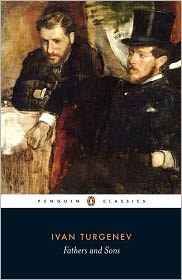
Fathers and Sons by Ivan Turgenev


Rating: 4 Stars
[Translated from the Russian by Rosemary Edmonds]
Ivan Sergeyevich Turgenev (1818-1883) was among the first of 19th. Century Russian writers to win both acclaim in Europe and popularity at home. Fathers and Sons, considered his most successful work by many, was published in 1861, and deals on the social end with the political reforms introduced to Russia at the time. Closer to the heart, it’s about the age-old struggle between the generations to understand another. George Bernard Shaw would seem to have said it right that, “it is all that the young can do to for the old, to shock them and keep them up to date”.
The stormy petrel of the novel, Bazarov, seems to apply that rule anyway. Not that Bazarov looks to jolt anyone; he is merely a practicing ‘nihilist’, a term so outdated today as to appear quaint. As he tells another character,
“In these days the most useful thing we can do is to repudiate – and so we repudiate.”
“Everything?”
“Everything.”

Among the things Bazarov repudiates wholesale are all governmental institutions, philosophy, art, nature, faith, love, marriage, and tender sentiments. In our day, he might well appear to be a candidate for Prozac, but Bazarov is so over-poweringly robust, confident and derisive, that the milder souls around him are set all atwitter with admiration, intrigue or irritation.
Bazarov’s young friend, Arkady looks up to Bazarov as his mentor, and makes patent efforts to adopt an attitude and philosophy that is alien to his own nature. In truth, Arkady is more like his shy, liberal, and music and nature loving father, Nikolai Kirsanov than he wants to admit. Kirsanov is hurt by the growing distance between him and his son, and perceives that Bazarov’s influence over Arkady is responsible for it, but he is too good-natured to hold a grudge against him for that. Arkady’s uncle, Pavel Petrovich, a man who is aristocratic by birth and temperament, bristles at Bazarov’s flippant manner to him, and is less forgiving than Nikolai. Anna Odintsov, a beguiling young widow is attracted to Bazarov, but will brook no threat to her independence and comfortable lifestyle.
Bazarov, who by all rights should be insufferable, is nevertheless a winning character. He has intelligence, integrity, and a sense of humor, and is by no means as invulnerable as he makes himself out to be. Like Arkady, he too is a much-loved son, and there is a pathos and tenderness in the way his elderly parents dance around his every wish, in terror of wearing out his patience with their affection. Neither is Bazarov , though certainly far from being sensitive, completely indifferent to them.
The picture we get of Russia in the second half of the 1800s is of a country in the throes of a dubious reform. The Liberals, Radicals and old land-owners are in deep contention with one another. The serfs, despite their abject poverty, ignorance and disorganization, are already seen as a danger if not an imminent menace. Well, we know how that story played out. ‘Fathers and Sons’ though considered a highly political novel at the time of its publication is now less about political trends and ideologies that wax and wane with the times. Its meaning to us, living in a different age, lies in those values on which Bazarov dispenses his scorn, that yet outlast every generation and live on undyingly into the next.

Thursday, July 28, 2011

The Adventures of Huckleberry Finn by Mark Twain


Rating: 4 Stars

‘The Adventures of Huckleberry Finn’ – now there’s an appropriate title. Not from Twain the post-modern magic act where the plot vanishes, and the poor reader is subjected to interminable longueur meandering through the protagonists’ rich and complex inner lives. The best novelists understand that inner and outer lives are not mutually exclusive.

The story picks up where ‘Tom Sawyer’ left off. Thanks to their dashing exploits in the first book, both boys have become local heroes, and accumulated a tidy little sum of money in the bargain. Motherless and under-parented Huck along with his disreputable father, have hitherto been mostly ignored and ostracized by the community. Now, to his misery, he finds himself clasped to the town's grateful bosom. Poor Huck; all he yearns for is to live out his vocation to be a shiftless bum. Unfortunately, the Widow Douglas is undaunted in her campaign to ‘sivilize’ and Christianize him. His troubles, however, are just starting. Once his mean father hears of his son’s windfall, he is back in his life to assert his paternal authority. Through an act of sheer inspiration, Huck escapes both his father and the fetters of society. He soon discovers someone who has even more reason to make a run for it – Jim, a fugitive slave. The two of them, on their journey down the Mississippi river encounter thieves, murderers, con men, and feuding Southern families; and all that before they can find a solution to their own problems.

Huck is an archetypal American hero – the wide-eyed naĂŻf, who sees the world more clearly than many around him. He is an ideal narrator for a picaresque novel – his dispassionate account of no-good scoundrels and his deadpan observations are the author’s ironic commentary on his times. Twain mines a seemingly inexhaustible vein of humor that makes light of the values and lifestyle of the South. One of my favorites, for example, was when the feuding Grangerfords and Shepherdsons attend church, toting guns while the sermon goes on endlessly about brotherhood, and ‘such-like foolishness’. This inspires his hosts to prattle about so many virtuous and noble topics that the beleaguered Huck confesses that it was ‘one of the roughest Sundays I had run across yet’.

There are points where the narrative takes a dark turn. Despite Twain’s rollicking sense of humor, this is not a book that has the all-embracing good will of say, To Kill A Mockingbird. There are many occasions where we see human nature at its worst, and there is a savagery to the satire. In Twain’s world, it’s not just about the vicious preying on the innocent. Cupidity thrives when it meets stupidity - that’s the unattractive truth. It’s easy to detect that Twain is amused rather than outraged by rogues, and in his view, it’s not people’s eagerness to exploit one another that is scandalous. Rather, the real tragedy as Huck sadly observes is that,

 "Human beings can be awful cruel to one another."
 
Twain’s use of the common vernacular and his stringent humor did not win him universal popularity. This flagship work of American Literature remains to date one of the most challenged books in the U.S., and the fourth most banned in American schools. On hearing that the public library of Concord, Massachussets had banned ‘Huckleberry Finn’, Twain wrote an ironic letter thanking them for boosting sales. More evidence that censorship doesn’t work – never has, never will.

Which is not to say that the objections are unfounded; this is one book that is as controversial as it is beloved, as flawed as it is great. One of the charges against it is racism. The pejorative term for people of African origin, 'n.....’ appears a staggering 219 times from first chapter to last. Twain’s views on race are complicated, to say the least. On the other hand, his feelings about slavery are unequivocal. It may be interpreted that Huck’s journey down the Mississippi is a metaphor for the transformation he undergoes in his feelings towards Jim, who becomes more than a runaway slave, rather a dear friend whose life and freedom are of vital importance to him.

When it comes to technique, Twain is not one of those meticulous-minded authors who dot the ‘i’s and cross the ‘t’s. His paints gloriously, messily, with a child’s abandon. Persnickety critics may find fault, and yes, strictly speaking there are faults to be found. For example, the introduction of Tom Sawyer towards the end seems an uncalled for intrusion. Why did Twain do it? Perhaps, because he felt, like many readers, that that irrepressible rascal, as much as he unnecessarily complicates things, also makes them more fun. Or perhaps, to him the  boys were inseparable, two sides of the same coin. As one critic perspicaciously observed, ‘Tom Sawyer was who Twain was; Huckleberry Finn was who he wanted to be.’

Wednesday, May 25, 2011

Dracula by Bram Stoker


Rating: 4 Stars

Pity the Vampire. He’s been sadly diminished in the ranks of mythical monsters. Whereas once he was a demonic menace to be thwarted with holy relics and garlands of garlic; now he’s the love-object of moony-eyed women in frothy fantasies. In movies he’s portrayed by preternaturally pale pretty boys who engage in soulful romances. It’s enough to make any self-respecting vampire gnash his long canines in rage. Meanwhile, serious readers cling to their classics like they were almighty crucifixes, in an attempt to ward off this terrifying surge of inanity. If you want to see evil, shorn of any pretense of glamor, it’s better to turn to the original.

The conjunction of ‘Frankenstein’, ‘The Strange Case of Dr. Jekyll and Mr. Hyde’, and ‘Dracula’ forms the unholy trinity that laid the foundation for Horror fiction, which truly came into its element in the 20th. century. Though I have an unabashed preference for classics, Horror is not a genre that I’m enthusiastic about. I certainly did not expect to enjoy ‘Dracula’ to the extent I did.

There are three main strands to the plot. First, we see Jonathan Harker, a newly-minted solicitor on business in Transylvania. He’s been engaged by Count Dracula to act as his agent in the purchase of estates in England. The meticulous-minded but naĂŻve young man soon realizes that he’s a prisoner, not a guest of the sinister count. Leaving him locked up in his castle, Dracula makes his way to England, where Lucy Westenra, a fluffy-brained but sweet-natured young woman pays a high price for her sleep-walking tendencies. Alerted to the menace that threatens London, four gallant young vampire-hunters under the leadership of the steely-willed Professor Van Helsing make it their mission to hunt down the monster.

It’s a commonly known fact that Bram Stoker based his 1897 book, on a Romanian prince – Vlad the Impaler, son of Vlad Dracul – whose cruelty was legendary, and far more shudder-invoking than any work of fiction. Stoker was a journalist, and this reveals itself in the book, as the entire story unfolds in the form of journals, letters, or news articles. Not the most direct form of narration but it’s a testament to Stoker’s story-telling skills that despite this circuitous technique, the story loses not an iota of suspense or narrative tension. Stoker’s oeuvre is a page-turner; and you cannot say that about too many books that are more than a hundred years old.

 The story is told from multiple viewpoints, and each journal entry or letter conveys with a charming ring of realism the character of the person writing – whether it’s in the intimate confidences between two young women, or a memo by a traveller to get the recipes of new dishes for his fiancĂ©e. On the whole, the sensibility pervading the book is refreshingly modern. The book’s main characters are each individuated, but they have one thing in common, a touching but quite believable earnestness and nobility of purpose. In his depiction of evil too, Stoker shows nuanced subtlety; as in the deranged behavior of Renfield, an inmate at the lunatic asylum; the victims who become victimizers in their turn; and, the count who is a monster now but was not always so.

The problem with the slew of contemporary publications dealing with the undead as their subject is that, they glorify and romanticize that which should be reviled. For horror to be taken seriously as literature, the work has to be informed with a moral intelligence – an awareness of the existence of good and evil, and allotting each to its rightful place in the scheme of the universe. Lacking that, it’s nothing more than junk food for the brain.

Wednesday, April 20, 2011

Jane Eyre by Charlotte Bronte


Rating:  3 & 1/2 Stars

It needs to be said – ‘Jane Eyre’ is not the greatest love story in English Literature. It is a truth universally acknowledged that Jane Austen’s ‘Pride and Prejudice’ is the best goddamn romance since pen met paper. So, where does that leave Charlotte Bronte’s 19th. century masterpiece? Somewhere in the top three, I would say, though my personal favorite is the other Bronte sister.

Misused and spunky little orphans have consistently proven to be a great windfall for story-telling. When we first see Jane at the age of 10, she is the lonely, barely tolerated ward of Mrs. Reed, the wife of her deceased uncle. Even then we’re charmed by her passion, undiminished sense of self-esteem, and fearlessness. It’s established in the very first chapter that here’s a heroine worthy of both our sympathy and respect. This is not someone to walk over.

When Jane turns particularly recalcitrant, Mrs. Reed packs her off to the Lowood Insititution for girls, a wretched charity school, where the penny-pinching manager, Mr. Brocklehurst enforces punitive lessons in patience and self-denial through a regimen of quasi-starvation, semi-indigence, and the ruthless squashing of any signs of incipient feminine allure. Even in these abysmal conditions, Jane finds friends, supporters, and some modicum of happiness. By the time she is eighteen, this bright and diligent young woman has been working as a teacher in the same school that she entered as a student. But by now she’s restless and longing to stretch her wings beyond the confines of the only world she has known. Not one to wait for life to happen to her, she advertises for the post of governess, the one respectable career for an educated woman in those days. She receives and accepts an offer at Thornfield Hall, and settles down there to teach Adele Varens, the little ward of Edward Rochester, the Master of Thornfield, and you guessed it, the hero of our story.

Jane’s meeting with Rochester turns the usual conventions of romance on its head. When they first see each other, Jane is no swooning damsel in distress in urgent need of rescuing by a handsome swain. Rather, it’s the masterful and imposing Rochester who’s caught in an awkward moment, and it’s Jane who goes to his assistance. Nor is it love at first sight. Jane is neither over-whelmed nor particularly drawn to her employer. She merely finds him interesting, though she does change her mind to fall irrevocably in love with him later. But there are very real obstacles in the way. Will Jane surrender all to the smoldering attraction between her and Rochester; or will she walk away, her integrity intact? More to the point, will these two ever wind up together?

It’s said that authors should write about what they know. Bronte must have believed this, because her descriptions of the boarding school, the circumstances of a female teacher, and the romance between a young woman and an older man, are all partly autobiographical. There’s a strong undercurrent of realism to much of the book. Her moral indignation at religious hypocrisy and social oppression would do credit to Dickens. The Gothic element is well-used but kept in hand, adding atmosphere to the narrative without being maudlin and over-powering.

One drawback to the book is that, really, no one else in the book is as convincingly characterised as Jane. The plentiful religious allusions put a damper on the spirit of Romance. It is noticeable that when the tone turns in that direction, the language too becomes ponderous and stilted. It’s probable that Bronte felt that all these pious sentiments would counter weigh the book’s portrayal of unabashed desire and ‘inappropriate’ behavior. That wasn’t a good judgment call. It didn't stop people from being scandalized when the book was published in 1847 under the pseudonym, Currer Bell. A renowned female reviewer of the day denounced the book and the heroine, and ominously hinted that if the author was indeed a woman, then she must be a ‘fallen’ one.

Still, a book is just as easily remembered if not for doing something the best, then for doing something else first. In Jane Eyre, the indomitable heroine is the delight – a strong unconventional woman, who will neither forgo her heart nor her self-respect, and who lives not by the narrow standards of society, but her own principles. Observe a skeptical Jane’s encounter with a self-proclaimed fortune-teller, who demands of her,

“Why don’t you tremble?”
“I’m not cold.”
Why don’t you turn pale?”
“I am not sick.”
“Why don’t you consult my art?”
“I’m not silly.”

Monday, April 4, 2011

The War of the Worlds by H.G. Wells


Rating:4 & 1/4 Stars

H.G. Wells’ (1866-1946) predecessor, the French writer, Jules Verne, was a fascinating story-teller. However, by modern standards, his books fall short on the scientific know-how, and technical details, that are so essential in anchoring this genre to the realm of the believable. The War of the Worlds, published in 1898, in its vivid recounting of space travel, mechanical monsters, predatory aliens, a post-apocalyptic Earth, and a plausible explanation for how this all came to be cleared the way for science fiction as we know it today. 

The unnamed Narrator tells us how at the turn of the century, invaders from Mars land on England, intent on conquest and occupation. The reaction of the general populace is rather dampening. As the Narrator wryly remarks,

“So some respectable dodo in the Mauritius might have lorded it in his nest and discussed the arrival of that shipful of pitiless sailors in want of animal food. ‘We will peck them to death tomorrow, my dear.’”

This phlegmatic response doesn’t last long. Once more of the Martian cylinders start bombarding the earth, and the tripods begin strafing the earthlings with their laser guns, people start panicking in the oldest traditions of humanity – rioting, looting, and scrambling for safety. Wells was perhaps not a big believer in the heroic potential of men. Depending on your perspective, the story’s conclusion might be seen as either ironic or anti-climactic. 

Written as it was at the tail-end of the nineteenth century, this is one classic where the language is accessible. Wells had an ear for the common accent, which somehow makes the story more probable than a cast of characters stiffly enunciating the Queen’s English. There is a chilling lack of sentiment to the narration. The breakdown of law and order is described in a methodical manner; and when the Narrator meets with the artilleryman, the latter’s prognosis for the future of mankind is as bleak as it is utterly logical.

Wells treatment of the topic isn’t to cow his audience with shock and awe. He gradually ratchets up the tension, and trusts the reader to allow his imagination to fill in the gaps. If only more modern authors would emulate that technique.

Monday, March 28, 2011

Frankenstein by Mary Shelley


Rating: 3 & 1/2 Stars


Once in a while, the author’s life is just as compelling as their work. Mary Shelley (1797-1851) hardly led a fairy-tale existence, but it certainly sounds like something out of a book. She was born to parents distinguished for their literary achievements. Her mother, Mary Wollstonecraft, was an early feminist, who wrote A Vindication of the Rights of Women. Her father, William Godwin, was known for his radical political views. Her home was frequented by eminent personalities from every field, including many scientists. Her mother died soon after her birth, and young Mary had a lonely childhood, writing stories to entertain herself. 

Her more or less obscure existence went up in flames when, at the age of sixteen, she eloped with Percy Shelley, one of the principal and most controversial poets of the Romantic Age. Since Shelley happened to be inconveniently married to someone else at that time, this brought down English society’s wrath on their heads. The two fled to Europe, where they enjoyed the company of Percy’s friend, the even more scandalous poet, Lord Byron. One rainy summer in Switzerland, Byron challenged his companions to come up with a horror story. The others of his company failed; Mary Shelley at the age of nineteen was the only one to rise to the occasion. The result was ‘Frankenstein, or The Modern Prometheus’ (pub. in 1818).

Victor Frankenstein, a promising young man with a scientific bent of mind, becomes obsessed with creating life. He manages to patch it together from body parts procured from cadavers, who are presumably, beyond the stage of offering any protest at the idea. The actual process of how this piecemeal humanoid was animated is left to the imagination. No sooner does Frankenstein succeed in his venture than he is overcome by revulsion at what he’s done, but it’s too late. He’s set in motion a chain of events that spell doom for him and all that he loves.

Frankenstein like the Creature of the story also owes its origins to many influences. In an academic sense, it’s a lit. lover’s delight with its various allusions to classical mythology, scientific interests of its age, theology, philosophy, Milton’s Paradise Lost, and, that very modern topic – bioethics. That it’s a work of the Romantic period of English Literature is evidenced by the detailed descriptions of natural scenery; protagonists motivated by adventure, love and sacrifice; and, a noble, tragic hero.

The other prominent influence is Gothic. Frankenstein is very much a novel in the Gothic mode, and this alas, is what holds it back. There are gaping holes in the logic, the plot stretches the limits of credulity, and emotions are overwrought, to say the least. These characteristics earned it the derision of other writers of the age, like Jane Austen. These very noticeable flaws were perhaps the reason for the Gothic novel to fade out of fashion, leaving the corridors of the imagination wide-open to be haunted by the exponents of Horror.

But perhaps, Frankenstein’s finest contribution is not merely in its reflection of the various literary trends of the age. Rather, it is the exploration of the spirit of scientific endeavor – the questioning of man’s efforts to overcome the limitations set on us by Nature. In our efforts to replicate life, or harness nuclear energy, or in our wreaking irreparable damage on our environment in the name of progress, are we also, like Victor Frankenstein, dancing recklessly close to the precipice of disaster? There is nothing so alluring to the enquiring mind as the pursuit of knowledge…and nothing so perilous to humanity as too little of it.


Wednesday, February 23, 2011

The Strange Case of Dr. Jekyll and Mr. Hyde


Rating: 3 Stars

First published in 1885, Stevenson’s novella failed to attract much attention for a month or two, before it suddenly surged to popularity and became a best-seller of its time. Reading it, I was wondering if it really qualified as horror, since it wasn’t, well, very horrific. But technically speaking, it is rated as horror, since it has all the necessary literary elements that are the hallmarks of this genre. 

The story is told from the viewpoint of Mr. Utterson, a lawyer who is a close friend of Dr. Henry Jekyll. The good-hearted Utterson is troubled by Jekyll’s association with the unsavory Edward Hyde. He fears that his friend is somehow being compromised by the latter, but how? Is Hyde Jekyll’s blackmailer, or his illegitimate son? Actually, Utterson’s character doesn’t voice these possibilities, but we can hear him thinking them. The lawyer is filled with even more foreboding for Jekyll’s safety, when the doctor makes out his will in favor of the much younger Hyde. A murder is committed, and deaths ensue before Utterson’s questions are finally resolved. 

‘The Strange Case of Dr. Jekyll and Mr. Hyde’ is unlikely to raise even the smallest icy prickle in the spine of a veteran fan of Horror fiction. Poor Stevenson, it’s not his fault we need merely turn on the evening news to have our sensibilities inundated with stories that fill us with fear and loathing. Today’s horror writers are compelled to elaborate ever further on gore-soaked and flesh-crawling details to elicit anything more than a tepid response from a desensitized reading public. 

Stevenson, to his credit, is a wonderful story-teller. Though this book was written a couple of years before Jack the Ripper began his spree of  terror, Stevenson brings before our mind’s eye the fogs roiling around the dimly lit streets of nineteenth century London – a place where menace, in the stunted form of Hyde, lurks around every corner, and the suspense rises to a shrill crescendo. This book predates medical diagnoses of psychopathic personality disorder, and holds a unique place in Literature in its study of human nature torn between good and evil. It was a prototype for the many horror/thriller books that followed in its wake.