Showing posts with label A Few of My Favorites. Show all posts

Wednesday, August 22, 2018

Killers of the Flower Moon - The Osage Murders and the Birth of the FBI by David Grann


Rating: 4 Stars

History books don’t cover all that we ought to know. So thank god for nonfiction literature and for investigative journalists like David Grann. In his stellar hit, Killers of the Flower Moon, he reconstructs an almost forgotten story of criminal conspiracy and racial injustice that should be required reading for anyone interested in the history of the United States.

In 1921, an Osage woman is reported missing and is soon found dead. She isn’t the only one. Within the space of a couple of years, 24 people, mostly Osage, are murdered; some with brutal violence while others were suspected to have died of slow poisoning. Frustrated with their local law enforcement, the terrorized Native American community demands federal intervention. Enter the fledgling Bureau of Investigation, later known as the FBI. What is uncovered is a ruthless plot where the high and low of society are involved in the criminal exploitation of the Osage. If discovering the perpetrators was a Herculean endeavor, obtaining justice for the dead proves to be an even more challenging task.

KotFM is mesmerizing narrative nonfiction that has the pulse and pace of the best crime fiction. I would have liked a little more suspense, but the author telegraphs the key suspects from the onset. Perhaps that’s because this is historical and was widely reported in its day.

Grann covers the story from three main perspectives. One is of the FBI. Blasé as we have now become with the wonders of modern forensic science, this period recalls an age where crime scene investigation was still in its nascency. Adding to that, the wild, wild, west was a place that was fundamentally hostile to federal law enforcement. But the Osage Reign of Terror highlights the nation’s desperate need for agents of the law who were unswayed by local political interests.

This is also the case that brought J. Edgar Hoover to the limelight. While we certainly learn quite a bit about the man who became synonymous with the Agency he directed for several decades, it is an agent called Tom White who represents the human face of the Bureau in its investigation into the Osage murders. In a story of mind-boggling greed and malevolence, White’s integrity and decency shows that the flawed America of that day (and this day) is a multi-faceted place where good and evil exist side by side.

Ultimately, however, it is the story of the Osage that holds center-stage. A people who have been hounded and persecuted for centuries face yet another round of callousness and depraved indifference at the hands of their tormentors. Though the crime might have been solved, justice is not served; not really. When one group of people habitually preyed on another, and habitually faced little to no consequence, there can be no legal redress. We can only hope that somewhere along the way we are learning something from history, as our species wearily inches its way forward.

Friday, July 13, 2018

The Narrow Road to the Deep North by Richard Flanagan


Rating: 4 & ½ Stars

2014 Booker Prize

If I had done my usual due diligence before picking up this book, I would have discovered that this was yet another book about World War II. Not just about the Second World War, but a story about Japanese POWs. Then I would have avoided it; because reading ‘Unbroken’ was traumatizing enough, and why would I go through something like that again? But that would have been my loss.

Flanagan’s TNRTTDN is in equal parts ravishing and heart-breaking. The crux of the larger narrative is the building of the Burma Railway in 1943 – a construction feat engineered by the Empire of Japan, on the backs of forced labor and under the most savage conditions. The human cost of the Death Railway, as it was otherwise known, was horrific: an estimated 102,000 people – 90,000 civilian laborers and 12,000 Allied prisoners perished in the effort. The deaths were due partly to tropical illnesses; but overwhelmingly, the ultimate reason was the barbarous indifference of Japan to human life and suffering.

On a more intimate scale, the story is about the Australian POWs – those who succumb to the Death Railway, as well as its survivors. Flanagan, whose own father was one of the Australian survivors, has invested the historical narrative with depth of research and poignant humanity. The toll of building the railway is explored through the perspective of different POWs; as well as through the eyes of their embattled Japanese tormentors – men who were tasked with performing the impossible and who would give no quarter because they belonged to a time and culture where clemency was equated with weakness.

But TNRTTDN is also a love story. The novel’s protagonist is Dorrigo Evans – a senior medical officer at the Burma Railway who later becomes a renowned surgeon. Evans seems to have a charmed life in many respects. As an officer, he was not subject to the same privations as the other prisoners at the labor camp, and afterward he’s, quite rightly, hailed as a hero. But the public éclat that’s lavished upon him, and the good fortune of having family and friends leave no impression upon Dorrigo, obsessed as he is with the woman who got away, the love of his life – Amy Mulvaney.

One of the motifs of this book is the vastness of human history – the bewildering force of circumstances beyond our control that shape the destinies of nations and individuals. The other is the inexorable sweep of time in erasing all events, men, and man-made things. What may remain is memory. Remembrance is important – hence the seemingly endless stream of books that exhume old wars and past injustices. We remember our history so that we do not repeat its mistakes. But cling too desperately to the past, and we lose our happiness in the present. Few books I’ve read have expounded this as eloquently as ‘The Narrow Road to the Deep North’.

Saturday, January 13, 2018

Hillbilly Elegy by J.D.Vance


Stars: 4 Stars

I did not grow up in the U.S.A. So, my first introduction to Hillbillies was through those lovable fictional transplants to California. I refer to the TV show – The Beverly Hillbillies. I never thought about hillbillies after that, till coming to America. Then it slowly began to sink in, that for whatever reason, hillbillies were not held in fond esteem by the rest of the country, and I couldn’t see why. One of the things about being an immigrant is that there are some cultural nuances that we just won’t get. For example, when it is generally agreed that stereotyping is harmful, why then is it not considered offensive to label some poor people as ‘white trash’. I have heard that term casually tossed around in pop-culture, while another word is delicately expressed as the ‘n-word’. There seems to be a double standard there that I don’t understand.

In his memoir, Hillbilly Elegy, J.D. Vance explores the complexity of his family roots; and in the process, gives us an insider’s scoop into the hillbilly culture – the good, the bad, and the ugly sides of it.

“Our elegy is a sociological one, yes, but it is also about psychology, and community and culture and faith.”

Though Vance proudly identifies as a hillbilly, in his case, it is more an identity of culture and ethos. His hillbilly grandparents had eloped as teenagers from the hills of eastern Kentucky to start their life together in a suburb of Ohio. His beloved grandparents, Mamaw and Papaw, briefly enjoyed their share of the American dream, reaping the windfall of the industrial boom of the Fifties. However, they and their kin also exemplify self-destructive behaviors and attitudes that blight their chances of happiness and prosperity. As we see in Vance’s book, some of his family grow in awareness; and make conscious decisions to exercise better judgment, make better choices; simply, to live better. Because they’ve seen first-hand the alternative to that – living as their own worst enemy; no outsider can do to them what they do to themselves.

Despite his interest in sociology and his research, Vance does not write like an academic. I say that as a point in his favor. The statistics he cites, and the writers he references serve to anchor his personal narrative more securely. Because ultimately, it is his story that held my interest – the family lore; the grandparents who try to amend the mistakes of their youth by being the rock of their grandchildren’s life; the poignancy of a childhood held hostage by an unstable parent; and most importantly, the resolution that neither the odds stacked against him nor any possible inherited genetic traits would doom his destiny. I found that self-assertive optimism made this a remarkably ‘American’ book in every sense.


Saturday, November 15, 2014

A Man Called Ove by Fredrik Backman


[Translated from the Swedish by Henning Koch]

Rating: 3 & ½ Stars

This sweetheart of a novel from Sweden marks Fredrik Backman’s debut into the literary world. Hugely popular in Europe since its publication in 2012, it has charmed American readers as well. Its appeal is transparent – a feel-good book with depth and insight, and just enough orneriness to keep it from becoming too clichéd.

Ove himself does seem a little familiar at first glance – a grumpy man, hopelessly behind the times, fanatically insisting on rules that no one else seems to care about. He’s a man one respects, a man one feels sorry for, a man about whom one might make a light-hearted joke – he’s not necessarily someone you like.

But Ove has a secret. His late wife, Sonja, knew it; and by the middle of the book, the reader starts suspecting it too; long before getting the official confirmation in the final chapter – a confirmation that sends his neighbor, Parvaneh, into a fit of inappropriately hysterical laughter.

The reasons for this book’s popularity are visceral. It strikes an instant chord – on true love, real friendship, the meaning of community – all the right stuff. However, to its credit, it doesn’t gloss over the inherent unfairness of the world; a world where terrible things happen to good people all the time; the systemic indifference of bureaucracies that fail those it’s meant to help; and, where without being actually evil, people exhibit varying degrees of obnoxiousness.

Ove, who has been a fighter all his life, has finally reached the point where he doesn’t want to fight anymore. With his beloved Sonja gone, all he wants is to call it quits, but finds it impossible to do so. People keep insinuating themselves into his life - needing help, needing guidance, needing somebody to fight for them. To a man who has fearlessly done the right thing all his life, it’s not easy to do anything else. Ove may have given up on life, but Life refuses to give up Ove.

The book does stumble here and there. While subtle and understated in its depiction of the different layers of human complexity, the humor does come off as occasionally clumsy and farcical. Backman’s depiction of women and children also borders on caricature. But those are minor flaws when the writing breathes a heart and soul into this story of what it truly means to live the good life.

Discussion Questions for this book at:

http://noa-betweenthelines.blogspot.com/2014/11/fredrik-backmans-man-called-ove.html


Wednesday, September 3, 2014

The Little World of Don Camillo by Giovanni Guareschi


[Translated from the Italian by Una Vincenzo Troubridge]

Rating: 4 Stars

It was by sheer accident that I came across this lovely little book many years ago. I found it in the small library of the small town that I was living in at that time, sorted under a note that read, ‘Librarian’s Recommendation’. I fell in love with the book, and the writer’s style all at once.

Guareschi, a WW II veteran and plyer of multiple trades, was the author and illustrator of the Don Camillo books, of which there are six. ‘The Little World of Don Camillo’ initiates the series with our introduction to the feisty priest Don Camillo, and his rival, Mayor Peppone of the Communist Party.

Less of a novel and more a connecting suite of short stories, the plot draws on the various clashes between Camillo and Peppone – be it Camillo’s refusal to baptize Peppone’s infant son with a name like ‘Lenin’; or, their feuding soccer-match; or, the ensuing ruckus when the Bishop visits their village.

Though they may lock horns in their battles to win the heart and soul of their community, these two ideological stalwarts have more in common than they want to admit. Despite his tendency to give fiery orations against the Church and its appointees, Peppone is at heart as much an Italian Catholic as anyone else in the village. Devout Don Camillo, though a man of God, is as free with administering lessons with his fists and feet, as he is with his sermons. But if the circumstances call for it, they will work together for their excitable and boisterous flock/compatriots.

This underlying conviction, that men of good intentions can, and will, put aside their differences for the greater good is the essence of the book – one of the reasons for its charm, that, and the benevolent take on humanity as evinced by Camillo’s confidante, the receptor of all his musings – the conversational Christ, who looks on with an equally tolerant eye on Camillo and Peppone alike.


Tuesday, March 12, 2013

The Godfather by Mario Puzo


Rating: 4 Stars

‘The Godfather’ is one of those books that leave me awash in memories – how the first time I read it, I finished it in one breathless sitting; how my friends and I discussed character and motive with a passion that better students would have reserved for Shakespeare; and more recently the recurrent allusions to the book and movie versions that echo in other icons of popular culture – be it ‘Seinfeld’, ‘The Simpsons’, or the various movies that are unself-conscious in referencing this work. The chance to read it again was an offer I couldn’t refuse.

The book begins with the wedding of Vito Corleone’s daughter. While FBI agents parked outside the house take note of the guests, the Don accepts the homage of underworld vassals and hears the entreaties of supplicants. The Godfather, Don Corleone, the head of the most powerful of New York’s five mafia Families dispenses justice like an ancient god, either smiting mightily or granting favors according to his discretion. But even gods fade out of fashion, and neither the Don’s legendary sagacity nor his sons’ fierce loyalty can withstand the changes surging upon the fortunes of the Corleone family.

One reason for this book’s visceral appeal is the effortless ease with which it taps into our fascination with power - power untrammeled by feeble notions of legality, or the greater good, for in the Don’s mind, he is the greater good. Yet, a closer glance reveals that Puzo is not an unsophisticated writer waxing eloquent about the glories of violent aggrandizement. In this world everyone pays the price; every victory comes at a cost.

‘The Godfather’ is a rare example of a book whose understanding would be incomplete without its movie version, and it needs to be said that while the book may be an engrossing read it’s the movies that are true works of art. Partly the credit for the movies too belongs to the author because Mario Puzo co-wrote the screenplays for The Godfather and The Godfather II, in both instances sharing the Oscar award for Adapted Screenplay with Francis Ford Coppola, the director. Whereas in the book the consequences of the ruthless pursuit of ambition were merely hinted at, with the cinematic adaptation the author is able to complete the narrative arc he had started.

While Puzo freely admitted that his motive behind writing ‘The Godfather’ was to make money, yet he shows flashes of brilliance in limning human nature, and in his plot construction. There is an operatic crescendo to the waxing and waning of the Corleone family’s power from the onset to the brilliant climax. If Vito Corleone is portrayed as a Machiavellian Robin Hood, the concept of original sin colors the depiction of all the characters in the novel, both major and minor. The teetotaler family man who supports many dependents and carefully plans his children’s education happens to be a corrupt cop; the battered wife is a shrill, self-serving harridan; kind-hearted Sonny, who is incapable of lifting a finger against the truly defenseless is also a savagely brutal mobster – these richly swirling complexities give hue and depth to the novel that redefined Family and family business.

Wednesday, January 16, 2013

The Round House by Louise Erdrich


Rating: 3 & ½ Stars

2012 National Book Award Winner

Erdrich’s powerful coming of age novel is set on a Native American reservation in North Dakota. The narrator, Joe Coutts, tells the reader of his thirteenth summer when his mother is brutally attacked and nearly killed. Joe watches as his hitherto safe family life disintegrates before his eyes when she slips away into a depression that seems irrevocable.

There are striking parallels between ‘The Round House’ and that all-time American classic, 'To Kill a Mockingbird'. The book however has been infused with the author’s own themes.  Chief among them is Joe’s shattered innocence. Erdrich’s account of the complex emotional lives of teenaged boys is compelling…and unsettling. Joe and his three friends, Cappy, Angus, and Zack - free of over-protective parents - smoke, drink, and engage in behavior that spans the spectrum from thoughtless to bone-chillingly dangerous. Yet they are a likable bunch of kids - fiercely loyal to one another, funny, protective of the ones they care about, angry at a world that is toothless in the face of evil, and genuine in their love or lust. They do not so much grow up, as have their childhood wrenched away from them in a series of excruciating incidents.

More tender is the intimate picture of family life drawn with intuitive sensitivity. Having grown up the center his parents’ lives, Joe is left bereft and confused when his mother retreats from her husband and son, seemingly beyond reach in her isolation. Joe’s father carefully tries to rebuild their broken world while trying to elicit the truth of the attack from her.

Erdrich opens a window into a world where blood quantum is used to determine a person’s status as Indian, where people are both in the mainstream as well as immersed in their heritage, and the old wounds of racial injustice and exploitation still strike a raw nerve. It’s interesting that the author, who is herself, like her characters, Native American, does not use that term when speaking of her people. The preferred word is Indian, and her descriptions of life on the Reservation evoke a culture that is American, minus the stereotypes.

Wednesday, July 18, 2012

Gone Girl by Gillian Flynn


Rating: 4 Stars

It had me at the first page, and kept me hooked till the last. So many ‘suspense’ novels telegraph their grand climax well before the reader is half-way through that, we nearly forget the enjoyable sensation of being kept on tenterhooks. It’s nice to get an occasional reminder once in a while.

Nick Dunne, on the day of his fifth anniversary returns home to find his wife, Amy, missing. He calls in the police, and the search begins in the small town of Carthage, Missouri. The evidence points all too damningly to the usual suspect in such cases. While there may be more than one side to any story, Nick’s perspective on his tottery marriage and his spouse does not win him much sympathy. The scariest place to be is inside someone’s head, and Flynn leads us into the darkest nooks and crannies of her protagonists’. The distinction between being a self-absorbed jerk and a narcissistic psychopath may be merely a difference of degrees.

Predictably the hunt for Amy soon turns into the usual media circus; with ratings-hungry talk-show hosts quivering with self-righteous outrage, slick attorneys, and casual acquaintances avid for their fifteen minutes in the spotlight.

Gone Girl scores an enviable double whammy. It’s a thriller that beckons with a promise of sexy, wicked fun, and before we know it, has us by the throat with its ferocious intelligence and startlingly acute insight.

There are some questionable angles, but it’s easy to overlook those when the author has gratified in so many other respects. One of the charms of this book is the way it slyly upends clichés – the lawyer who is the go-to guy for uxoricide suspects is apparently happily married; romance’s cherished ideal of a knight in shining armor is not every girl’s idea of the perfect man; incorrigible love-birds are annoying to the rest of us, as Nick nastily remarks on his grieving in-laws "cherishing each other" every chance they get. And while hope may be ‘the thing with feathers’, love can and does sport scales, fangs, and claws.

Wednesday, January 4, 2012

Steve Jobs by Walter Isaacson


Rating: 4 Stars
Americans place a high premium on ‘nice’. It’s a trait pointedly applauded when exhibited by movie stars, top-ranked athletes, and aspiring electoral candidates. One of the most popular films in the recent past has been ‘Forrest Gump’, in which Tom Hanks played the seraphically sweet titular hero, who, despite his sub-average intellect accomplishes one incredible success after another. Face it, this is a country where ‘over-achiever’ is not a compliment; unless the achievements are accompanied by an attitude of “Aw, shucks, it ain’t nuthin’”. Not that I have anything against ‘nice’, and ‘Forrest Gump’ is one of my favorite films. Realistically however, we know that greatness often goes hand in hand with glaring imperfections; that a good man need not be particularly agreeable; and, that ‘nice’ is just one quality among the pantheon of virtues.
That’s why I found the wave of articles about Steve Jobs immediately following his death needing a pinch of salt. Of course, the whole point of eulogies is to accentuate the positive, but these were wandering dangerously close to hagiology – gentle St. Steve of Silicon Valley. As such, they were at odds with earlier stories detailing his legendary short fuse, his hogging credit for the ideas of other people, and abusive tirades. Isaacson’s compassionate, yet candid biography sets the record straight. The author was understandably leery when Jobs approached him to write his life-story. At that time he was unaware of Jobs cancer prognosis, knew enough about him to be skeptical when he went on the charm offensive, and didn’t trust him to restrain his controlling impulses when it came to a depiction of his life. However, he found himself becoming intrigued with the idea despite his reservations, and the result is a deeply thoughtful study, that is as intense as the iconic founder of Apple.
The story of Jobs parentage adds to his legend – the offspring of unmarried students, his adoption by Paul and Clara Jobs was a providential act of destiny that blessed him with selfless parents who set aside their needs to focus on a brilliant, temperamental child who showed early signs of the man he would become. Jobs would feel the influence of his father throughout his life in his desire for faultless craftsmanship. The fascination with design seems to be his own. It is noticeable that all the enduring relationships of Jobs' life (his parents, his wife, at least three of his four children, and his closest friends) were possible because the other party accepted him as he was, difficult as he could be.
Early in his life, Jobs turned to many men for guidance, and initially at least, his mentors seemed as taken with him as he was with them, before mutual disillusionment and feelings of betrayal set in. The world of business may be dog-eat-dog, but Isaacson gives us a balanced perspective by allowing both Jobs and his adversaries their fair say, before weighing in with his analysis. He is sympathetic to John Sculley, who was in the unenviable position of ousting Jobs from his beloved Apple in 1985. Similarly, his assessment of another formidable rival of Jobs, Microsofts’s Bill Gates, is both admiring and respectful. The differences between Jobs and Gates owed more to divergent business philosophies than personal animus. While Gates and many other critics of Jobs were appreciative of the man and his achievements, it is perhaps characteristic that Jobs himself seemed unable to return the compliment, persisting in his solipsistic view of the universe.
This would perhaps lead us to question his much talked about spiritual leanings. But in this as in other ways, he was truly unique. While he might have brutalized his employees, and proved himself unforgiving to those he considered his foes, and unyielding even to his dearest circle of family, Jobs' spirituality was innate and genuine. It could be seen in his unostentatious lifestyle; the sense of aesthetic that wedded functionality and beauty; his intuitive understanding of consumer needs, and yes, a certain integrity in an environment that didn’t make integrity easy. Despite his failings, Jobs continues to mesmerize, and that isn’t merely because he possessed a rock-star charisma evinced by no other CEO. In a world where the profit margin is given over-riding importance, his career is an example of innovation, an instinctual ability to harness creativity, visionary leadership, and the fostering of a corporate culture that engendered, indeed, enforced excellence.
“…a lot of us want to contribute something back to our species…We try to use the talents we do have to express our deep feelings, to show our appreciation of all the contributions that came before us, and to add something to that flow. That’s what has driven me.”
Jobs inspires because he made exceptional and uncompromising use of the time, opportunities, and gifts endowed upon him.

Tuesday, December 13, 2011

A Christmas Carol by Charles Dickens


Rating: 4 Stars
It's the most wonderful time of the year…that very special time when a certain segment of the population takes offense to the well-intended ‘Happy Holidays!’, and fumes about putting the Christ back in Christmas. The rest of us are too busy to quibble about such matters being occupied with revving up the shopping carts. After all, economists are on anxious stand-by to measure the pulse of our moribund economy, which rises and falls with consumers’ willingness to max out their credit cards. Isn’t it our patriotic duty to throw frugality to the wind, and dance our way to debt in tune to the marketers’ pied piping?
Bah! Humbug!’ as my favorite miser would say.
Sometimes, I think this great nation could do with a dash of the original spirit of Ebenezer Scrooge, who was not such a bad old sort after all, except maybe his priorities were a bit misplaced. But then, I’m rather partial to Literature’s most beloved penny-pincher. To call Scooge thrifty would be a euphemism; he is a tight-fisted man of business, whose true failing is being miserly in spirit, and not merely in spending habits. He neither enjoys the fruit of his labor, nor can he brook the humble joys or infirmities of another. He is, in short, a man badly in need of miraculous redemption.
That’s precisely what he gets: first, in the form of an unwelcome visit from the spirit of his deceased partner, Jacob Marley, who gives him dire warning of the consequences of continuing his present course; and then, in succession, visits from the ghosts of Christmas Past, Present, and Future.
This was a tale that was highly popular even during Dickens’ time, when he would read it aloud at well-attended public gatherings. (Dr. Seuss, took a page from his book, and delivered his own kiddie classic, ‘How the Grinch Stole Christmas!’) A Christmas Carol’s perennial charm lies in that belief so unshakeable in every die-hard optimist – the basic goodness of man. Smart, funny, feisty Scrooge shouldn’t be consigned to eternal hellfire and damnation; not when a gentle reminder, a long-overdue awakening, and, a timely caution are all that it takes for him to re-examine his life.
Ultimately, this book successfully gets through what religious authorities don’t always convey: that the afterlife is no great cause for concern as long as we’re living our best life, right here, right now. On that note - to those of you who celebrate this season, Merry Christmas!  And to all, peace and joy. May you love truly, spend wisely, and live well.


Thursday, November 24, 2011

The Sense of an Ending by Julian Barnes


Rating : 4 Stars
2011 Booker Prize
Julian Barnes’ latest book is a slender one, a little over a 150 pages. Don’t let its size fool you; it has all the density of a black hole.
The narrator, Tony Webster, is edging slightly past the point that can still be truthfully called middle age. Still, he is at peace with that, more or less; because as he says in his defense, he’s a ‘peaceable’ man. He’s experienced friendship, love, loss, marriage, fatherhood, divorce, career, retirement – the whole kit and caboodle. Whatever uneasy thoughts he might have about death are eclipsed by a recurring fear of Alzheimer’s – that great erosion of the mind.
The problem of memory is one seared into our consciousness when a series of events force Tony to re-evaluate everything he thought he knew, about himself and his loved ones. As one exasperated ex-girlfriend tells him over and over again – ‘you don’t get it and you never will’. I would like to say there’s a twist at the end, but it would be more accurate to state that the story’s arc is as sinuous as memory can be, when it is at its most capricious and self-inventing.
“…what you end up remembering isn’t always the same as what you have witnessed.”
Barnes style is lovely…and refreshing. Just as we accustom ourselves to his elegant, cerebral manner of expression, he jabs us into alertness with needle-sharp humor, and efficiently placed profanity. When we think we’ve got to know a character fairly well, we’re shocked that the same person had it in them to lash out viciously, albeit in hurt and rage, spilling words that splash like hot acid. Yet, why should we be surprised at all; the book vividly brings home the impossibility of knowing another, when we do not know ourselves. That makes it all the more gratifying when our narrator, defying his ex's opinion of his cognitive abilities, finally ‘gets it’.
Once Barnes received the Booker, which some felt was long overdue, there was the inevitable gossip about the book's merit. I came across two others that were also on the 2011 shortlist – ‘The Sisters Brothers’, which I really enjoyed; and, ‘Jamrach’s Menagerie’ which I tossed aside in boredom after having got partway through the book (if imitation is indeed the highest form of flattery, Yann Martel must be quite flattered). Not every Booker winner of the past has had my unqualified enthusiasm, but this time, I would say that the honor given to Barnes was richly deserved.

Wednesday, November 2, 2011

My Family and Other Animals by Gerald Durrell


Rating: 4 Stars

Book Club November 2011 Pick

The literary universe offers endless possibilities for those of us with a critical bent of mind; predisposed to entertain ourselves with the analysis, assessment, and evaluation of books. There are however times when we have to admit defeat. There are some books that we have read too often, loved too well, and enjoyed too much to the extent that our perspective is hopelessly compromised. Those are the times when we shut the door on that opinionated little inner voice, and surrender ourselves to the enchantment of being transported to another world, where plot conventions have no more meaning than stylistic devices. Thank God for those occasions, and how I wish there were more of them.
Published in 1956, ‘My Family and Other Animals’ is an affectionate chronicle of the adolescent years that Durrell spent on the Greek island of Corfu with his eccentric and always entertaining family. The venturesome Durrells emigrate to Greece in the 1930’s in search of some balmy weather, and literary inspiration. The move is instigated by Larry, the eldest in the family. Lawrence Durrell (who later gained literary fame with works like his Alexandria quartet) is portrayed as a provocative gadfly of a personality – brilliant, caustic, and witty. Rounding off the rest of the family is the widowed Mrs. Durrell, and Gerald Durrell’s two other siblings – Leslie and Margo. Each character is endowed with their own peculiarities that are depicted with great relish. Fans of Gerald Durrell’s style of humor will savor this unconventional family’s quirks, and their assortment of equally colorful friends.
“…It was originally intended to be a mildly nostalgic account of the natural history of the island, but I made a grave mistake by introducing my family into the book in the first few chapters…by exercising considerable cunning…I managed to retain a few pages here and there which I could devote exclusively to animals.”
Gerald Durrell went on to become both a popular writer, and a renowned zoologist and conservationist. This book gives us a glimpse into the early propensities that made these dual careers as natural as they were inevitable.
Whether the animals are more or less diverting than the humans populating the narrative is a moot point. What colors the humor of the memoir, and lends it its irrepressible joie de vivre is the appreciation of individuality wherever it is found; and apparently it is found everywhere. What is also found in abundance is that other precious commodity – beauty. When Durrell is not delighting with his exuberant, over-the-top humor, he beguiles with writing that never fails to drown me in its loveliness, no matter how often I read this book. Whether it’s the breathtaking verve in his tale of an encounter between a gecko and a mantis that is recounted as a battle of epic proportions; or, descriptions of sumptuous family picnics and get-togethers, the details are rendered in stunningly exquisite prose.
The memoir, as I’ve said elsewhere in this blog is the most slippery of nonfiction genres. The successful memoirist engages his audience’s interest by playing a wily game of revelation and concealment, as enticing and illusive as any fan dance. This book is no different in that respect. Ultimately, the reasons I love My Family and Other Animals are complicated and deeply personal. Suffice it to say that, every time I lose myself between its covers, I rediscover with a sense of wonder and grateful relief, that what delighted once delights still. The dearest books have this in common with the dearest friends…we outgrow neither.

Tuesday, October 25, 2011

The Sisters Brothers by Patrick DeWitt


Rating: 3 & 1/2 Stars
It’s almost a reflex reaction; anytime I think of the old West, I hear Ennio Morricone’s unforgettable score whistling in my mind’s ear, and feel Clint Eastwood emanating his stubble-cheeked, squinty-eyed charisma. From this the reader should be able to discern that hitherto, I’ve only seen Westerns. Patrick DeWitt’s Booker-shortlisted, ‘The Sisters Brothers’, is my first introduction to the literary genre. I must say I enjoyed the sheer novelty of it.
In 1851, at the onset of the California Gold Rush, notorious gunslingers - Eli Sisters and his brother, Charlie - have been commissioned by the Commodore to kill a man named Hermann Kermit Warm. The Sisters brothers set forth to Sacramento to finish the job. On the way, they meet gold prospectors, malevolent witches, spiteful children, whores, and all manner of tough customers in a series of incidents that are rivetingly surreal.
The two siblings make great character studies. Eli, wearying of his violent life, and looking for a peaceable alternative, tries to persuade his elder brother that it’s time to call it quits. Charlie, more of a natural-born killer than Eli, is reluctant to give up the only thing he’s really good at. They have their disagreements, but know all too well that in their line of work, a brother’s presence means the difference between dealing out death, and being at the receiving end of it.
The humor in this book is of the macabre sort, and goes nicely with the deftly sketched if, quixotic characters. It seemed to me that for a pair of hired killers, Eli and Charlie do spout off some mighty high-falutin’ dialogues; but as I said, I’m a novice to the genre, and can’t really comment on the book’s overall credibility as a Western. What stuck with me though were the brothers; DeWitt has created a pair of stone-cold murderers who are, dare I say it…endearing.
Related Reading:
True History of the Kelly Gang by Peter Carey
Carey won the 2001 Booker Prize with his wonderfully written version of the life and times of Ned Kelly, Australia’s most famous (infamous?) bushranger. Carey’s Kelly is a winsome character, and though the book may not be a guaranteed crowd-pleaser, it's a literary tour de force.

http://noa-betweenthelines.blogspot.com/2011/08/true-history-of-kelly-gang-by-peter.html

Monday, September 26, 2011

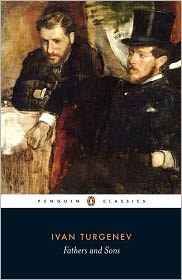
Fathers and Sons by Ivan Turgenev


Rating: 4 Stars
[Translated from the Russian by Rosemary Edmonds]
Ivan Sergeyevich Turgenev (1818-1883) was among the first of 19th. Century Russian writers to win both acclaim in Europe and popularity at home. Fathers and Sons, considered his most successful work by many, was published in 1861, and deals on the social end with the political reforms introduced to Russia at the time. Closer to the heart, it’s about the age-old struggle between the generations to understand another. George Bernard Shaw would seem to have said it right that, “it is all that the young can do to for the old, to shock them and keep them up to date”.
The stormy petrel of the novel, Bazarov, seems to apply that rule anyway. Not that Bazarov looks to jolt anyone; he is merely a practicing ‘nihilist’, a term so outdated today as to appear quaint. As he tells another character,
“In these days the most useful thing we can do is to repudiate – and so we repudiate.”
“Everything?”
“Everything.”

Among the things Bazarov repudiates wholesale are all governmental institutions, philosophy, art, nature, faith, love, marriage, and tender sentiments. In our day, he might well appear to be a candidate for Prozac, but Bazarov is so over-poweringly robust, confident and derisive, that the milder souls around him are set all atwitter with admiration, intrigue or irritation.
Bazarov’s young friend, Arkady looks up to Bazarov as his mentor, and makes patent efforts to adopt an attitude and philosophy that is alien to his own nature. In truth, Arkady is more like his shy, liberal, and music and nature loving father, Nikolai Kirsanov than he wants to admit. Kirsanov is hurt by the growing distance between him and his son, and perceives that Bazarov’s influence over Arkady is responsible for it, but he is too good-natured to hold a grudge against him for that. Arkady’s uncle, Pavel Petrovich, a man who is aristocratic by birth and temperament, bristles at Bazarov’s flippant manner to him, and is less forgiving than Nikolai. Anna Odintsov, a beguiling young widow is attracted to Bazarov, but will brook no threat to her independence and comfortable lifestyle.
Bazarov, who by all rights should be insufferable, is nevertheless a winning character. He has intelligence, integrity, and a sense of humor, and is by no means as invulnerable as he makes himself out to be. Like Arkady, he too is a much-loved son, and there is a pathos and tenderness in the way his elderly parents dance around his every wish, in terror of wearing out his patience with their affection. Neither is Bazarov , though certainly far from being sensitive, completely indifferent to them.
The picture we get of Russia in the second half of the 1800s is of a country in the throes of a dubious reform. The Liberals, Radicals and old land-owners are in deep contention with one another. The serfs, despite their abject poverty, ignorance and disorganization, are already seen as a danger if not an imminent menace. Well, we know how that story played out. ‘Fathers and Sons’ though considered a highly political novel at the time of its publication is now less about political trends and ideologies that wax and wane with the times. Its meaning to us, living in a different age, lies in those values on which Bazarov dispenses his scorn, that yet outlast every generation and live on undyingly into the next.

Thursday, September 8, 2011

Chronicle of a Death Foretold by Gabriel Garcia Marquez


Rating: 4 Stars
[Translated from the Spanish by Gregory Rabassa]
Gabriel Garcia Marquez was awarded the Nobel Prize for Literature in 1982
My few experiences with South American writing have left me both fascinated and apprehensive. I have been especially curious about Columbian-born Gabriel Garcia Marquez, among the most pre-eminent of Latin American novelists. I decided to first test the waters by gingerly swirling a toe around some of his lighter books, before taking the plunge into his more acclaimed works. Chronicle of a Death Foretold happened to fit the bill perfectly.
Part detective story and part investigative journalism; this slim novella still packs a mighty wallop. It’s partly based on events from the author’s life, though altered for fiction. In the very first page, we learn that the narrator is looking back into a murder that took place in his town some twenty-seven years ago. He meets and speaks with his fellow townspeople, most of them family and friends, or neighbors of many years standing. They have all played a role in the events that took place on the fateful day, by what they did and what they didn’t.
There is not a lot of suspense to the story, but I’ll try not to give anything away. A wedding precedes the murder, and the murder coincides with the Bishop’s fleeting visit to the town. Both the wedding and the Bishop’s visit have a great bearing on the death. Intertwined with the killing are themes of ‘returned’ brides and family honor; with many memorable characters, including matrons who prophesy that certain young women would be good wives because ‘they’ve been raised to suffer’. As seems to be the case often in South American fiction, there is love and lust - unwieldy, unpredictable, and completely beyond the bounds of reason and etiquette.
The story proceeds backward, tracing each and every incident that leads to the final, shattering climax. The description of the actual murder is horrifyingly graphic. Marquez is remorseless in the details, and the reader is so entranced by the compelling narrative that we can only behold, mesmerized, the tragedy that unfolds before our eyes. So it must have been with the townsfolk. One thing that is made painstakingly obvious is that there were several occasions to avert this misfortune, yet each of those opportunities went to waste; and that raises poignant questions about human nature and predestination.
The killers themselves come out as rather hapless; nor do they bear the burden of guilt alone, not when the whole town appears complicit in the crime. Each character is strikingly lifelike, even though for many it’s only a cameo appearance. By and large, Marquez eschews Magic Realism in the novel except in the final scene which has all the psychedelic vividness of a terrible dream.

Thursday, September 1, 2011

Battle Hymn of the Tiger Mother by Amy Chua


Rating: 3 Stars
There’s a funny story about the Asian Family’s grading system:
A – average
B – bad
C – crap
D – Don’t bother coming home
At this point, no doubt I’ve ruffled some feathers. Let me explain. This ‘joke’ was told to my sons with great relish and complete seriousness by their Chinese American class-mates.
In her book, ‘Battle Hymn of the Tiger Mother’, Amy Chua, American-born offspring of Chinese immigrants, Yale Law school professor, and the mother of two daughters elaborates on the principles of Chinese parenting that frequently results in high-achieving child prodigies. Chua does have some first-hand insights into the situation. Her daughters, Sophia and Lulu (Louisa), are both academically bright and musically gifted – in piano and violin respectively.
There is aptitude, and then there is inborn talent. Even among the talented, there are degrees of innate ability. Those of you who have read ‘Outliers’ will be familiar with one theory as to why some succeed, while others fail to reach their full potential. Those of you who have not read that book will probably have less sympathy for Chua, and her style of extreme parenting. There will likely be many tsks of disapproval at some of her Gestapo techniques, if not shocked outrage. Is Chua’s child-rearing brutal, myopic and regressive, or is it dedicated, single-minded and selfless? I will reserve my opinion on the matter and leave you to form yours. But one has to admit, it takes a brave/thick-skinned mother who will lay bare her parenting methodology to the cynosure of the world.
As can be expected, the book has generated a lot of talk, with Chua being excoriated by some and applauded by others. I would say that she was courting controversy with the subtext to the title which includes the phrase ‘why Chinese parents are better at raising kids’. For those predisposed to dislike her views, the author offers herself as a walking target, not only in the unrepentant tongue-lashings and psychological abuse she heaps on her children, but in her many pungent opinions: denouncing astrology in one sentence but then proudly identifying herself and her daughters with the Chinese zodiac for the full run of the book; her scathing indictment of some white men’s overwhelming preference for Asian women, while importantly adding that her good self was the one and only Chinese woman her white Jewish husband ever dated. You could be offended, or you could choose to be amused by the unintentional humor.
Personally, I found this a highly engaging book, but not one to be taken too seriously. Its interest to the reading public lies not in any parenting solutions that she offers, but in the many legitimate questions that are brought up about what it takes to raise a successful, happy child. Chua’s signal error is in identifying certain core virtues, such as hard work, respect, commitment as ‘Chinese’; then imposing them mercilessly on her daughters. My quibble would be that while she assails her children with these notions, she herself fails to follow certain other virtues that are also traditionally ‘eastern’ – wisdom, patience and restraint.
There’s a vapid generalization about tiger mothers vs. mother bears. While there’s a part of me that would like to chime in and say that it takes a human being to raise another human being, honesty compels me to admit that on several issues, I’m on the side of the tiger; albeit its mild side, not its wild side.
Related Reading:
‘Outliers’ by Malcolm Gladwell; Nonfiction
This is my favorite of all Gladwell’s books. Here, he expands the equation between success and hard work more persuasively and less offensively than Chua.
‘My Father’s Paradise’ by Ariel Sabar; Nonfiction
This book appealed to me with its sweet spirit and warm humor. That, and the fact that, despite geographical boundaries, and the differences in language and religion, the values of immigrants from the old world are astonishingly similar.

Thursday, July 28, 2011

The Adventures of Huckleberry Finn by Mark Twain


Rating: 4 Stars

‘The Adventures of Huckleberry Finn’ – now there’s an appropriate title. Not from Twain the post-modern magic act where the plot vanishes, and the poor reader is subjected to interminable longueur meandering through the protagonists’ rich and complex inner lives. The best novelists understand that inner and outer lives are not mutually exclusive.

The story picks up where ‘Tom Sawyer’ left off. Thanks to their dashing exploits in the first book, both boys have become local heroes, and accumulated a tidy little sum of money in the bargain. Motherless and under-parented Huck along with his disreputable father, have hitherto been mostly ignored and ostracized by the community. Now, to his misery, he finds himself clasped to the town's grateful bosom. Poor Huck; all he yearns for is to live out his vocation to be a shiftless bum. Unfortunately, the Widow Douglas is undaunted in her campaign to ‘sivilize’ and Christianize him. His troubles, however, are just starting. Once his mean father hears of his son’s windfall, he is back in his life to assert his paternal authority. Through an act of sheer inspiration, Huck escapes both his father and the fetters of society. He soon discovers someone who has even more reason to make a run for it – Jim, a fugitive slave. The two of them, on their journey down the Mississippi river encounter thieves, murderers, con men, and feuding Southern families; and all that before they can find a solution to their own problems.

Huck is an archetypal American hero – the wide-eyed naïf, who sees the world more clearly than many around him. He is an ideal narrator for a picaresque novel – his dispassionate account of no-good scoundrels and his deadpan observations are the author’s ironic commentary on his times. Twain mines a seemingly inexhaustible vein of humor that makes light of the values and lifestyle of the South. One of my favorites, for example, was when the feuding Grangerfords and Shepherdsons attend church, toting guns while the sermon goes on endlessly about brotherhood, and ‘such-like foolishness’. This inspires his hosts to prattle about so many virtuous and noble topics that the beleaguered Huck confesses that it was ‘one of the roughest Sundays I had run across yet’.

There are points where the narrative takes a dark turn. Despite Twain’s rollicking sense of humor, this is not a book that has the all-embracing good will of say, To Kill A Mockingbird. There are many occasions where we see human nature at its worst, and there is a savagery to the satire. In Twain’s world, it’s not just about the vicious preying on the innocent. Cupidity thrives when it meets stupidity - that’s the unattractive truth. It’s easy to detect that Twain is amused rather than outraged by rogues, and in his view, it’s not people’s eagerness to exploit one another that is scandalous. Rather, the real tragedy as Huck sadly observes is that,

 "Human beings can be awful cruel to one another."
 
Twain’s use of the common vernacular and his stringent humor did not win him universal popularity. This flagship work of American Literature remains to date one of the most challenged books in the U.S., and the fourth most banned in American schools. On hearing that the public library of Concord, Massachussets had banned ‘Huckleberry Finn’, Twain wrote an ironic letter thanking them for boosting sales. More evidence that censorship doesn’t work – never has, never will.

Which is not to say that the objections are unfounded; this is one book that is as controversial as it is beloved, as flawed as it is great. One of the charges against it is racism. The pejorative term for people of African origin, 'n.....’ appears a staggering 219 times from first chapter to last. Twain’s views on race are complicated, to say the least. On the other hand, his feelings about slavery are unequivocal. It may be interpreted that Huck’s journey down the Mississippi is a metaphor for the transformation he undergoes in his feelings towards Jim, who becomes more than a runaway slave, rather a dear friend whose life and freedom are of vital importance to him.

When it comes to technique, Twain is not one of those meticulous-minded authors who dot the ‘i’s and cross the ‘t’s. His paints gloriously, messily, with a child’s abandon. Persnickety critics may find fault, and yes, strictly speaking there are faults to be found. For example, the introduction of Tom Sawyer towards the end seems an uncalled for intrusion. Why did Twain do it? Perhaps, because he felt, like many readers, that that irrepressible rascal, as much as he unnecessarily complicates things, also makes them more fun. Or perhaps, to him the  boys were inseparable, two sides of the same coin. As one critic perspicaciously observed, ‘Tom Sawyer was who Twain was; Huckleberry Finn was who he wanted to be.’