Showing posts with label Book Club. Show all posts

Monday, January 28, 2013

One for the Money by Janet Evanovich


Book Club Pick – Jan. 2013

Jersey gal, Stephanie Plum, may be broke but she's too feisty to shy away from doing what has to be done. She takes up a job as a bounty hunter with her cousin, Vinnie. Her first assignment is tracking down Joe Morelli who has jumped bail and is wanted for murder. Morelli also happens to be the one who deflowered the teenage Stephanie several years back, and she still harbors some unresolved feelings for him. Her pursuit of Joe leads here to shady neighborhoods and dangerous characters; but she is determined to get her man, and more importantly, her money.

Along the way, Plum sustains some injury and humiliation, but also learns a bit of self-defense. When we see Morelli breaking his cover to save her neck, and cooking an appetizing meal for his would-be captor, you pretty much realize that this is the start of, if not a beautiful friendship, at least some sexual tension that will simmer through several books, leaving the reader to guess at the possible culmination of their relationship.

This is the first of Janet Evanovich’s Stephanie Plum novels. The reasons for the popularity of the series are understandable with the likable protagonist, the recreation of a tough New Jersey that stays true to its stereotypes, and, the combination of broad humor and quick-witted action.


Friday, August 24, 2012

Diana - Story of a Princess by Tim Clayton and Phil Craig


The Brits put on a nice show at the Olympics, didn’t they, synthesizing all the elements that make this island nation so unique – at once both a bastion of European tradition, and at the avant-garde of the arts and social trends. The segment where the Queen parachutes in with the redoubtable 007 was especially appreciated for its co-mingling of royalty and cheeky humor. For after all, what could be more English than the Queen of England?

Though as intrigued as the rest of the world might plausibly be about a lifestyle that includes tiaras, gracious hand-waving, and ribbon-cutting, I’ve always been a little skeptical about books that purport to tell us about the Royals as they ‘really are’, more so when they are penned by British writers. Those have always seemed to be either fawning tributes, or bitchy exposés. The best biographies are extensively researched; unsparing in recounting the pertinent details of the subject’s life; impartial in their analysis; neutral in tone, yet insightful; offering readers a perspective that would have otherwise eluded them. Judging by these standards, Clayton and Craig’s chronicle of the late Princess Diana’s life is a decent read, though its sympathy seems slanted more toward the Royals than Diana.

As you might know if you have ever read about the battling Windsors, the press always chose a side when describing the tensions between Diana and her then-husband – Charles, Prince of Wales. Most of the time, Diana appeared to have won the war for the public’s support. The beautiful, well-coiffed Princess with her global do-gooder image, and mega-watt charisma just made better copy than the noticeably stiff and reserved Prince. As to the truth of their marriage, who really knows? If you believed Diana’s version, she was a loving, vulnerable woman whose heart was broken by her insensitive, philandering cad of a husband. The Prince’s vociferous supporters might say that she was a bottomless pit of insecurity whose incessant demands for attention would wear down the patience of a saint. What is evident to the reader is that the union was perforce doomed from the start with the pair’s uncompromising personalities, and their readiness to seek solace outside their marriage.

But apparently, it wasn’t just Charles with whom Diana had a falling-out. Clayton and Craig charge that Diana opened hostilities on the entire Royal family over their perceived lack of support, and their belittling of all that she strove to do. It was a family feud that played out before a captivated world audience, and when one side proceeded to spill the beans, the other didn’t want to be left behind. The paparazzi, sensing a free-for-all gleefully jumped into the fray, at which point nothing was sacred, least of all notions of privacy or personal dignity.

Diana, had very early on, started a dangerous flirtation with the Press, smitten with the idea of her own celebrity. Like a woman not understanding the consequences of encouraging an obsessive suitor, she showed particularly poor judgment in her dealings with the paparazzi. When the fracas got out of control, and Diana felt herself being hounded on all sides, she attempted a retreat from public life, which didn’t last too long. The last years of the Princess’s life and her tragic death make a sad story; but as to who was to bear the blame for that is left to the readers’ discernment.

So, who was Diana? Was she a self-promoting Princess of ‘Wails’, a drama queen in search of an audience, a loose cannon barreling down the corridors of power? Or was she the angel of mercy that many thought her to be, an instinctive humanitarian with a near magical ability to channel compassion, and an intuitive empathy for those in pain? In the course of her turbulent, all too short life, she played many roles. No doubt people will believe what they want to believe.

Wednesday, April 25, 2012

The Reader by Bernhard Schlink


Book Club May 2012 Pick

[Translated from the German by Carol Brown Janeway]

Schlink’s 1995 book is both a disturbing story of forbidden passion, and a thought-provoking addition to Holocaust literature.

Michael Berg and Hanna Schmitz cross paths thrice in their lives, and each encounter leaves in its wake pain and confusion. One question that torments the protagonist is the difficulty of loving, or having loved one, whom moral sense as well as society constrains to condemn. The other is the even thornier issue of allocating individual culpability in crimes in which an entire nation is deemed complicit, if not by direct participation then in guilt by association.

Schlink writes like the law professor he is. The book is often dry with passages of tortuous rationalizing. Despite the ponderous style the author makes one thing clear: though many are guilty to some extent, others have been made convenient scapegoats due to their inability to mitigate the case against them.

Schlink raises questions of class and education in musing over one’s inclination towards crime, which as sociologists will attest, are factors too potent to ignore - generally speaking, that is. However, they don’t begin to give clues as to what happened in Germany in the first half of the Twentieth Century. On the book’s publication, accusations were made by some quarters that the author was attempting to validate Nazi atrocities. That charge seems unjustified. No purpose can be served by demonizing the perpetrators of genocide, or indeed any other act of inhumanity. Merely that some things cannot be understood is no reason to stop us from trying.

Thursday, December 1, 2011

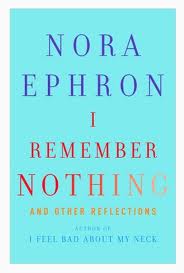
I Remember Nothing by Nora Ephron


Book Club January 2012 Pick
At first glance, Nora Ephron would seem to be one of those people who are born to write.  Author, director, and producer, she is the daughter of screenwriters; sister to three siblings, all writers; and, incidentally, the men she married happened to be writers as well.
Her latest book, ‘I Remember Nothing’ is a compilation of essays ruminating on various topics – her career, family, divorce, growing old. Essays may not be an accurate term here, since quite a few 'chapters' are Lists of 25 Reasons, and many of those reasons are simply reworded versions of the same idea. When a writer happens to be a Hollywood personality, I guess they can get away with a lot more than those who do it to pay the bills.
The book is also a casualty of that other illusion cherished by celebrity authors – namely, that every stray thought that meanders through their mind is worth sharing. The essay form does offer an opportunity to vent one’s grievances, and Ephron doesn’t hesitate to take advantage of it. Among those she’s peeved at – her departed mother; one of her three sisters; at least one of two ex-spouses (Carl Bernstein, journalist of ‘Watergate’ fame); people who were formerly her friends; people who are currently her friends but are not favorably impressed with her dessert-making abilities; migrating geese…the list goes on.
Humorists unabashedly mine their family and acquaintances as potential sources of bandinage, and that’s quite acceptable. But bitterness or self-pity can ruin that effect. It would be wise for a successful, famous woman to avoid sounding petty-minded, or, speaking ill of the dead.
There were parts of the book that I enjoyed. Ephron’s three screenwriting nominations are believable; she can write. Though I wish her choice of subject matter had been different, it was not an onerous task to read her book, meaning, it was not boring. Her essay about her induction to journalism captures the giddy exhilaration of a young woman finding her raison d’etre. Her take on divorce was both poignant and honest, and left me feeling more than a little sympathy for her. Her humor can take a wry, self-deprecating turn; she could have perhaps used that more. It’s no great challenge to wield a pen to show other people in a bad light; there's a greater subtlety to laughing at ourselves. We may as well; after all, others are probably already doing it.


Wednesday, November 2, 2011

My Family and Other Animals by Gerald Durrell


Rating: 4 Stars

Book Club November 2011 Pick

The literary universe offers endless possibilities for those of us with a critical bent of mind; predisposed to entertain ourselves with the analysis, assessment, and evaluation of books. There are however times when we have to admit defeat. There are some books that we have read too often, loved too well, and enjoyed too much to the extent that our perspective is hopelessly compromised. Those are the times when we shut the door on that opinionated little inner voice, and surrender ourselves to the enchantment of being transported to another world, where plot conventions have no more meaning than stylistic devices. Thank God for those occasions, and how I wish there were more of them.
Published in 1956, ‘My Family and Other Animals’ is an affectionate chronicle of the adolescent years that Durrell spent on the Greek island of Corfu with his eccentric and always entertaining family. The venturesome Durrells emigrate to Greece in the 1930’s in search of some balmy weather, and literary inspiration. The move is instigated by Larry, the eldest in the family. Lawrence Durrell (who later gained literary fame with works like his Alexandria quartet) is portrayed as a provocative gadfly of a personality – brilliant, caustic, and witty. Rounding off the rest of the family is the widowed Mrs. Durrell, and Gerald Durrell’s two other siblings – Leslie and Margo. Each character is endowed with their own peculiarities that are depicted with great relish. Fans of Gerald Durrell’s style of humor will savor this unconventional family’s quirks, and their assortment of equally colorful friends.
“…It was originally intended to be a mildly nostalgic account of the natural history of the island, but I made a grave mistake by introducing my family into the book in the first few chapters…by exercising considerable cunning…I managed to retain a few pages here and there which I could devote exclusively to animals.”
Gerald Durrell went on to become both a popular writer, and a renowned zoologist and conservationist. This book gives us a glimpse into the early propensities that made these dual careers as natural as they were inevitable.
Whether the animals are more or less diverting than the humans populating the narrative is a moot point. What colors the humor of the memoir, and lends it its irrepressible joie de vivre is the appreciation of individuality wherever it is found; and apparently it is found everywhere. What is also found in abundance is that other precious commodity – beauty. When Durrell is not delighting with his exuberant, over-the-top humor, he beguiles with writing that never fails to drown me in its loveliness, no matter how often I read this book. Whether it’s the breathtaking verve in his tale of an encounter between a gecko and a mantis that is recounted as a battle of epic proportions; or, descriptions of sumptuous family picnics and get-togethers, the details are rendered in stunningly exquisite prose.
The memoir, as I’ve said elsewhere in this blog is the most slippery of nonfiction genres. The successful memoirist engages his audience’s interest by playing a wily game of revelation and concealment, as enticing and illusive as any fan dance. This book is no different in that respect. Ultimately, the reasons I love My Family and Other Animals are complicated and deeply personal. Suffice it to say that, every time I lose myself between its covers, I rediscover with a sense of wonder and grateful relief, that what delighted once delights still. The dearest books have this in common with the dearest friends…we outgrow neither.

Monday, October 3, 2011

Unbroken by Laura Hillenbrand


Book Club October 2011 Pick

Readers who expect a lot from a book won’t be disappointed by ‘Unbroken’. It successfully crosses multiple nonfiction genres – historical, survival, biographical, and inspirational. It’s a fitting tribute to its centerpiece, Louie Zamperini, a man whose experiences are so remarkable that he seems to have rolled many lifetimes into one. It would be no exaggeration to say that a similar tale of fiction would be dismissed as outrageous beyond belief.
Though the story revolves around Louie Zamperini, ‘Unbroken’ is equally a consideration of World War II, starting with the U.S.’s entry into the war with the bombing of Pearl Harbor; the war experiences of servicemen stationed in the Pacific to confront the threat from the East; a searing account of the horrendous treatment meted out to Allied soldiers in Japanese POW camps; and, finally, the long road to rehabilitation faced by these veterans. In the very first chapter, Hillenbrand gives us a bird’s eye view of historical perspective, effortlessly navigating us into the pregnant pause between the two great wars of the last century. Her terrifyingly vivid description of the bombing of Funafuti brings us a little too close to the war for comfort.
Good writers know that it’s easier to get their readers involved in the more abstract aspects of their book, if they give them a human interest angle. While Louie Zamperini’s life is so exceptional that not everyone might be able to identify with it, it’s impossible not to be moved by the man himself. The early portions of Zamperini’s life are entertaining. We get a glimpse of an incorrigibly ungovernable boy who could find no positive outlet for his excess energy till his elder brother cajoles and browbeats him into sports. Zamperini quickly excels at running, with a high school record that was unbeaten for many years. He goes on to become a part of the U.S. track team for the 1936 Berlin Olympics, “the youngest distance runner to ever make the team”. He acquits himself well, and returns home a national hero.
The sure path to athletic glory is interrupted when he enlists in the Army Air Corps in 1941, putting his dreams on hold, like so many other young men of his generation. Louie becomes a bombardier and sees action in the Pacific, before his plane with its crew crashes into the ocean in 1943. Surviving as a castaway for an astounding 47 days at sea in an appallingly ill-fitted raft, Zamperini’s luck takes a turn for the worse when the vessel finally washes up on a Japanese-occupied island. There begins the second part of his ordeal - trying to make it through conditions intended to shatter any normal human being, with a tormentor who seems to be hell on two legs.
As engrossing as this book was, I gradually became aware of a slight unease and was able to put a finger on it only a third of a way through the reading. Japan’s war-crimes have been documented beyond refute, and  Hillenbrand’s depiction of the Japanese people is, on the whole, even-handed; which is not to say the book is free of bias. While Hillenbrand gives us the truth, I suspect that it is not the whole, unalloyed truth. The author’s perspective is loyal to the American experience of the Second World War. Nowhere is there any allusion to an American serviceman being anything other than an officer and a gentleman. Hillenbrand does not depict any event that would tarnish the image of the people currently idealized as ‘the greatest generation’. If the more unsavory actions of American soldiers have been either omitted or glossed over, it’s perhaps because this book is a heart-felt valentine to veterans of WW II. Well, a nation must celebrate its heroes, but I was a little discomfited at the unsubtle nudging to offer a standing ovation.
Zamperini’s story does not end with the war. So rarely is violence ensued by true peace, and yet for Zamperini it did. The third act of his life is a post-lude of amazing grace.
Related Reading:
‘Strength in What Remains’ by Tracy Kidder
The insanity of war is intensified when it is not hostilities between opposing nations, but erstwhile friends and neighbors turning on each other. How do we stop the madness? Pulitzer-prize winning author, Tracy Kidder, offers if not solutions, at least hope in his recounting of Rwanda’s recent civil war.
Life of Pi by Yann Martel
Like ‘Unbroken’, Martel’s Booker-prize winning novel is also one of survival, faith, and the unquenchable human spirit. A word of caution, this book didn’t win the ‘Booker’ for nothing. It’s like deep-sea diving; the treasures are hidden, and a superficial read won’t be rewarding.

Monday, August 8, 2011

And Then There Were None by Agatha Christie


‘Sakhi’ Book Club September 2011 Pick

“It was so difficult to do that the idea had fascinated me…I wrote the book after a tremendous amount of planning, and I was pleased with what I had made of it.”- Agatha Christie on ‘And Then There Were None’

Christie had reason to be gratified with how the book had turned out. First published in 1939 with a much more offensive title, of all the Queen of Mystery’s novels, this was her most popular work, with a hundred million sales. Original in concept, it is also considered among her best.

Ten people of varying backgrounds, most of whom have never met each other, are invited by a mysterious host to Soldier Island. Once there, they realize that they are at the mercy of a malevolent mastermind who knows all too much about them. For unsuspecting as they are, they are far from innocent. Each one has a skeleton rattling in their closet; and their unknown host seems privy to their guiltiest secrets. Very soon, people start to die, in grotesque accordance with a misanthropic and un-childlike rhyme. Who is going to be the last one left standing? Who could have done it?

Christie does not deceive with cheap tricks; she does leave her trail of clues, and all the evidence points to one suspect. Personally, for me, this was less of a whodunit, and more of a how-was-it-done, and that gets harder to configure as the bodies start piling up. Whether the plot stands up to the plausibility test is debatable, but the author astutely anticipates her critics' objections, and deftly parries most queries in the book's epilogue. The long and short of it is, Christie manages to pull off a superb trompe l'oeil on her readers.

Friday, April 22, 2011

Blink by Malcolm Gladwell


'Sakhi' Book Club April 2011 Pick

There are seven colors in the rainbow; we learn this in preschool. As we grow older, we learn something else; these seven colors and their tones are what we can actually see. Beyond that, there are more than 16 million colors in the visible spectrum. We will never see those colors, simply because our eyes were not designed to see them, though other species are. It strikes me that maybe Malcolm Gladwell is from another species too. Oh, I know his vision is likely limited to the basic visible spectrum like everyone else’s. Yet he seems to see more, and he is generous in sharing those insights. ‘Blink’ for one, is an eye-opener. 

Every moment – every blink – is composed of a series of discrete moving parts, and every one of those parts offers an opportunity for intervention, for reform, and for correction.

The premise of ‘Blink’ is simple: the quantity of time taken to arrive at a conclusion does not determine the quality of the decision, namely, split-second decisions can be just as good, very often better, than the ones made after great deliberation. As a corollary, our snap judgments are not infallible. We do make mistakes with our off-the-cuff choices. The good thing is that our instinctive responses can be educated and improved.

Galdwell’s métier is offering the reader a dazzling array of examples to prove that his theories can be evinced across the board, that they are in fact, part of an appreciable pattern. He does that here too. We are time and again introduced to art historians, psychologists, athletic coaches, military strategists etc. who use their expertise to engage in flawlessly accurate decision-making. The key-word is ‘expertise’. Innate talent and professional training aside, all these people have something in common. They are not theorists. They’ve put in the man-hours needed in their chosen fields and earned their experience, to the point that their skills have now become second nature to them. They are very, very good at what they do because they’ve been doing it for a long time, and because it is their passion.

As for the rest of us, we’re not going to be able to tell a genuine work of art from a fake, and thank god that no man's fate hangs on our instantaneous presumptions of his innocence or guilt. We will however, continually make snap judgments, because that is part of being human. Our senses feed us a constant stream of input. The problems occur because the filter to process all that feedback is more often than not corrupted, meaning, our judgment is distorted by our unconscious biases. As Gladwell elucidates in ‘The Warren Harding Error’, we too often judge a book by its cover, nor do we always even know what we want. Still less can we put them into words. 

He offers us cases of spectacularly bad decision-making and makes a simple but convincing argument that that in all those instances, good judgment was derailed by a combination of stress, lack of objectivity, lack of time, and/or an overload of information. As he succinctly observes, information is not the same as understanding. Perhaps, this is especially important to remember in the time of the Information Age, when we’re bombarded by useless tidbits of news from all sides. Keeping that in mind, perhaps a more selective approach to the plethora of data available to us would refine our judgment, to make it if not fool-proof, at least less error prone.

Sunday, March 13, 2011

To Kill A Mockingbird by Harper Lee


Rating: 4 & 1/2 Stars

1961 Pulitzer Prize Winner

'Sakhi' Book Club March 2011 Pick


A Literary Classic has at least four elements – artistic quality, universal appeal, the ability to stand the test of time, and lasting relevance. That’s a textbook definition. ‘To Kill A Mockingbird’ certainly has three of the four qualities. However, to say that it has stood the test of time might be a little premature, since it was published just about fifty years ago. Nevertheless, there is something so profound about this book, that we can confidently assert that it will be read for a long time to come. This is a masterpiece of values that are not merely enduring, but timeless.

Haper Lee’s book starts in the most innocuous way. The narrator, Scout (Jean Louise Finch), remembers the events of the onset of her ninth year. Growing up in America’s Depression Era in the Deep South, Scout witnesses the community of her small Alabama town, Maycomb. Her life is a sheltered one - a loving father; a protective elder brother who is her best friend and mentor; and, a housekeeper who tries to keep her in line. Her concerns are typically childlike – apprehension about school, her relationship with her best friend - Dill, and her terrified fascination of the reclusive Boo (Arthur) Radley, who has assumed the form of neighborhood bogeyman in the imagination of Maycomb’s children. Over the course of the next two summers, bigger worries loom on the horizon. Her lawyer father, Atticus Finch, takes on the case of a black man accused of raping a white woman. This agitates the otherwise peaceful little county. The Finch family faces the rancor of people’s objection to Atticus, who is the court-appointed defense: 

“…Atticus aims to defend him. That’s what I don’t like about it.”

Atticus Finch has no illusions about the world he lives in, but neither does he have any intention of letting justice be railroaded, without everyone at least getting to hear the real truth, ugly as it may be. The bitterness caused by the case, its aftermath, the climax, and the final catharsis are told in a serene, slightly detached tone that is far more effective than angry rants about injustice.

The story is enhanced by the complete absence of literary bombast. The characters speak in the colloquial, sometimes whimsical cadence that characterizes the best of the Literature of the South, from Mark Twain downwards. The simple but incandescent prose is further illumined by the humor that is such an integral part of this book. Lee’s comic sense and timing is akin to the twinkling of fireflies on a summer evening. Blink, and you’ve missed a glimmer of beauty.

This book preceded the passing of the Civil Rights Act of 1964. Fifty years after its publication, America can proudly claim to have made great strides in overcoming racial divides. After all, didn’t we just elect our first African-American/Biracial President? Progress certainly, but the United States is still a young country. It was not that long ago that Native Americans were driven from their territories, and marginalized in the very land of their birth. Not that long ago, that it was considered appropriate and necessary to exploit slave labor, or to inter Japanese-Americans on suspicion of their ethnicity. It took nearly a century after a devastating Civil War to recognize African Americans as full-fledged members of this country. The specter of racism has waned, not vanished. 

However, it's not merely in the political or social context that  ‘To Kill A Mockingbird’ is as relevant today as when it was first published. While this may be a novel as quintessentially American as apple pie, its themes of compassion, tolerance, faith, family, and community are boundless; beyond the claims of a particular era or nation. We would all be better for a slice of this pie.

Monday, February 7, 2011

Brooklyn by Colm Toibin


'Sakhi' Book Club Feb. 2011 Pick

Toibin’s ‘Brooklyn’ was shortlisted for the Booker Prize and earned rave reviews for the author. It tells the story of Eilis Lacey, who leaves her native Enniscorthy in Ireland to do what so many others do – gamble on the chance of finding brighter prospects in America. But even as she finds success and happiness in her new country, the call of home is too powerful for Eilis to resist.  

There is no literary fanfare to the story-telling; instead there is a quietness that allows the narrative to unfold at its own pace. This is in step with Eilis’ own nature, which is deeply serious, introverted and thoughtful. The relationships between Eilis, and her family and friends, are depicted with a fine delicacy, and the author lets the subtle undercurrents reveal themselves over the course of the story.

Many stories seem to reach out from the pages, and pull you into their vortex. This was not one that engulfed me in a similar way. A polite and proper distance was always maintained, but that is not a demerit in itself. Some books are meant to be ravenously devoured, some others to be more decorously appreciated. ‘Brooklyn’ belongs to the latter variety.

Tuesday, December 14, 2010

Into the Wild

 
‘Sakhi’ Book Club Jan. 2011 Pick

            Jon Krakauer’s books reveal his interest in people who live on the edge, pushing their frail physical resources to the extreme. “Into the Wild” is no exception. Krakauer candidly admits his fascination with the life and death of Christopher Johnson McCandless.

            McCandless is an absorbing subject. Coming from a privileged background, and apparently gifted in many areas, he tosses it all aside after graduating from college to embark on the life of a vagabond, calling himself ‘Alex Supertramp’. When his anguished family hears about him again two years later, it is only to learn of his death from starvation in the wilderness of Alaska. This was a tragically ironic end to an idealistic young man. Before abandoning the life he knew, McCandless had magnanimously donated the remaining $24,000 in his college fund to OXFAM, a charity dedicated to fighting hunger.

            The media exhaustively covered McCandless’s story. Jon Krakauer himself wrote about it for ‘Outside’ magazine. The feedback on that article was mostly excoriating, especially from native Alaskans, who deplored this attention given to a misguided, probably even mentally disturbed young man.

            Krakauer’s journalistic instinct, however suggested that there was more to this story than met the eye. His meticulous research turns up evidence of a multi-faceted youth, who though eccentric, was certainly sane. Alex/Chris defies easy pigeonholing; he was a charismatic loner who easily made a favorable impression on people he met. Apparently living a hippie life, he nevertheless adhered to the highest ethical values – personal dignity, no drugs, no rock and roll, no sex. What was his attraction to the wilderness? Was it the possibility of living a life unencumbered by society’s rules and expectations; was it part of an intense quest for spiritual fulfillment; or was it just a pie-in-the-sky delusion of an ill-prepared boy who thought he could take on the desolate wastes of Alaska?

            Jon Krakauer brings his usual intensity and thoroughness to this book as he does elsewhere. As to how Alex/Chris met his death, the author’s reasoning is quite convincing. He suggests many possibilities for McCandless's vanishing act into the Wild. However, by the end of the book Christopher Johnson McCandless is as intriguingly enigmatic as he was at the beginning, perhaps even more so.

Sunday, November 28, 2010

Major Pettigrew’s Last Stand by Helen Simonson


‘Sakhi’ Book Club Dec. 2010 Pick

In ‘Major Pettigrew’s Last Stand’, the inhabitants of Edgecombe St. Mary appear to be feeling the backlash of colonialism’s karma. They have hitherto practiced a genteel social segregation – a place for everyone and everyone in their place. But their Pakistani neighbors don’t seem to be following the rules – they’re refusing to use the service entrance at the clubhouses; questioning the traditional British perspective of the Indian sub-continent’s history; and horrors, even aspiring to hobnob with them as social equals.

The protagonist of Helen Simonson’s novel, Major Pettigrew, is himself a quintessential English gentleman, so rigid, that not only does he have a stiff upper lip, he also seems to have a very stiff poker inserted up a bodily cavity. The Major does not impress favorably at first sight. He seems to have a profound distaste for all things un-English, such as European couture, American commercialism, or even the notion of a more equitable sharing of one’s patrimony.

But a strange thing happens. Following the death of his brother, and a moment of sympathy from the local Pakistani shop-owner, Mrs. Jasmina Ali, he finds himself increasingly attracted to her. The Major and Mrs. Ali have a lot in common - both book-lovers, who are mourning the passing away of much-loved spouses, and whose family members impose shamelessly on them. They are both also very much a part of their own social world, though not averse to the other’s. Therein lies the problem. The Major’s English friends and neighbors make it plain to him that his ‘lady-friend’ could never truly be one of them. The Major, who has more than a few hypocritical bones in his body, has his doubts as well. Jasmina, hemmed in by her husband’s conservative Muslim family, has problems of her own to resolve. Will true love surmount all obstacles, or will it give in quietly to practical considerations?

The English comedy of manners is a hard act to pull off. It requires a deft, delicate touch accompanied by a spot-on skewering of society’s little hypocrisies and intolerance. Ms. Simonson has done a commendable job in this novel. Her witty, observant writing reveals that no single community holds the exclusive rights to small-mindedness and bigotry. She manages to peel away the carefully cultivated layers of national attitudes and cultural identities to reveal the imperfect, endearing human beings underneath. A promising beginning from a debutante author.

Wednesday, October 27, 2010

Snow Flower and the Secret Fan by Lisa See


'Sakhi' Book Club Nov. 2010 Pick

             Lisa See’s Snow Flower and the Secret Fan is a mesmerizing tale of love, misunderstanding, betrayal and remorse. Beyond all that, it’s a story of enduring female friendship.

            At the tender age of seven Lily is united in what is meant to be an eternal bond of love with her laotong, Snow Flower. Their new relationship is translated for English readers as ‘old sames’, which can be interpreted to be soul mates. This relationship is of the until-death-do-us-part kind. The novel clearly delineates men’s world and women’s world, which can never be one and the same. (It is left to us to understand by inference that a man can never be a woman’s kindred spirit.) Both Lily and Snow Flower grow up to marry, move away, and raise families, but never allow themselves to drift apart.

            In the 19th century Chinese culture that the author places her novel in, a woman’s life is one of sorrow. Unwanted from birth, regarded as a burden upon the household, a girl can redeem herself only through marriage, and producing a son (preferably many sons). Even then, she is at the mercy of her mother-in-law who has the final say in domestic matters. To ensure as satisfactory a marriage as possible, a young woman has to present to her future in-laws a pair of ‘golden lilies’, dainty child-sized feet. To achieve this feat of podiatric wonder, girl children had their feet bound in a process that could be fatal, and was always excruciating. Foot binding resulted in broken toes, restricted movement, and often precipitated osteoporosis. Even when successful, what was achieved was a pair of deformed little stumps that would probably not satisfy any modern foot fetishist.

            In Lily’s case, her perfect ‘golden lilies’ gain her entry into a higher social standing, a kind-hearted husband, and tolerable in-laws. She was the luckier of the two laotongs. As the two young women settle into lives very different from one another, their friendship shows some signs of strain though they are still true to their bond. That’s until the growing chasm in their lives shatters under a misunderstanding that unleashes Lily’s hurt, and subsequently, her ferocious anger.

            Lisa See anchors her story in the heart of Chinese culture and tradition. Though foot binding is thankfully a thing of the past, certain traditions still endure. The story’s protagonists communicate with each other through nushu, a script exclusively developed and used by women, though now the Chinese government is apparently trying to preserve this unique part of their linguistic history.

            While reading about another country’s social mores, the reader is fascinated and/or repelled by customs and values that are alien to his own, but the purpose and the power of fiction are to transcend these divisive barriers. It would be a rare woman who couldn’t identify in some way with either Lily or Snow Flower.

Monday, September 20, 2010

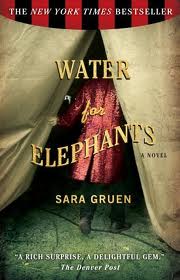
Water for Elephants by Sara Gruen


'Sakhi' Book Club Oct. 2010 Pick

In her book, Water for Elephants, Sara Gruen takes us back to a bygone era for a fascinating look into a Depression Era circus. The experience is akin to being taken on a magic carpet ride into a world of frenetic energy. She manages to capture both the gaudy glamor and the sleaze beneath the sequins, in her portrayal of the hard scrabble existence of its performers and workers.


 But that’s only one side of the story. There are two plots here, and one could almost say two heroes, because the elderly Jacob Jankowski, remembering his vanished youth at the Benzini Brothers Circus is nothing at all like his younger self. The younger Jacob, losing his parents and his prospective career in one tragic stroke, abandons his final exam at Cornell, only to stumble into a circus. He manages to secure a place for himself there once his veterinary training is discovered. To the cash-strapped Benzini Brothers’ Circus, a near-vet is better than none at all. At the circus, Jacob discovers love, enemies, and friends in the unlikeliest places.

As he continues his reminiscences, the elderly Jacob is eagerly waiting for someone (heck, anyone, he doesn’t care) to take him to the circus that has parked itself near the Retirement Home. The older Jacob is crusty, feisty, alone, terrified of old age and death, and yet indomitable. The author’s depiction of the Assisted Living Center is poignant in its minutiae of daily life.

It takes grace and wisdom to surrender to the inevitabilities of life. Yet perhaps, there is also something heroic about those who stubbornly refuse to “go gentle into that good night” and believe that,

“Old age should burn and rage at close of day;
Rage, rage against the dying of the light.
”

Ninety-three year old Jacob Jankowski will haunt my memory long after I forget the other details of this story.

There are some loose ends to the plot, and the writer initially sets us up for a climax, only to pull a surprising (and implausible) switcheroo, in an act of authorly legerdemain. However, it’s still a thoroughly enjoyable read that manages to effortlessly transport from one vividly imagined setting to another.

Thursday, April 22, 2010

The Curious Incident of the Dog in the Night-time


The Curious Incident of the Dog in the Night-time by Mark Haddon


'Sakhi' Book Club May 2010 Pick

Mark Haddon’s “The Curious Incident of the Dog in the Night-time” is a fresh, poignant coming-of-age novel with a most unusual protagonist – a fifteen year old autistic boy.

Christopher Boone is like one of the mathematical puzzles he delights in. The workings of his mind will be baffling to most people. Unusually bright with a proclivity for math and logic, his autism renders him blind and tone deaf when it comes to emotion – unable to fathom the complex nuances in social behavior that form the substratum of human relationships. Like his hero, Sherlock Holmes, his is an intensely analytical and deductive mind. However, we live in a world that often flies in the face of logic.

Determined to solve the mystery of his neighbor’s ‘murdered’ dog, Christopher sets about finding clues, only to stumble upon a secret in his own family that unnerves him, and to discover a truth that he finds terrifying. This sends him on a journey that, for one with his particular disorder, tests the boundaries of his considerable courage and resilience.

This is a book that effortlessly held my attention from beginning to end. The few characters who people this narrative are wonderfully depicted. As seen from Christopher’s dispassionate viewpoint, they come across as fallible, but moving, in their all too human inadequacies. The most compelling of them, is of course, Christopher, who defies our pity, and emerges from his trial, truly heroic.

Mark Haddon’s language and style is pitch perfect to the needs of this story, its tone catching the eccentricities of its literal-minded narrator, and faithfully echoing the other characters. The prime-numbered chapters prove to be more than a gimmicky distraction, giving us a window into the mind of Christopher, as do the many pictorial images, puzzles and diagrams. We never lose sight of the fact that we are in the presence of a very unusual and beautiful mind.

“Mother used to say that Christopher was a nice name because it was a story about being kind and helpful, but I do not want my name to be a story about being kind and helpful. I want my name to mean me.”

The author desrves commendation for keeping this story unflinchingly true to the paradox of Christopher’s character.

Thursday, April 15, 2010


The God of Small Things by Arundhati Roy

1997 Booker Prize

“The God of Small Things” is Arundhati Roy’s powerful account of a wildly dysfunctional Keralite family’s personal tragedy catapulted into hideous social injustice. The series of events leading to it, and its aftermath are seen through the eyes of Estha and Rahel, twinned in soul, and not just by accident of birth.

Besides its brilliant characterization, what lends power and force to this story is the author’s language – lyrical, passionate and sensuous. She excels at very luscious descriptions, and is really able to evoke the beauty of ‘small things’. She is equally good at evoking disgust and revulsion.

Explicit violence, graphic sex, a fixation with the male anatomy - and I felt that some of it at least, was just for effect. It seems intended to jolt the reader.

Its other drawbacks – her writing can also be jarringly idiosyncratic, riddled with metaphors that don’t always work, generously sprinkled with obscenities, and annoyingly precious. When she meanders into the morass of regional politics, her tone becomes oddly flat and unconvincing. Her social criticism oscillates between heartfelt pathos, and strident hectoring.

But her delicate irony, and wicked sense of humor illuminate an otherwise joyless story. She writes like an angel, whenever she’s talking about or through the children. If I ever read this book again, it would be solely for that reason. Though a lot of the book deals with ugly matters, what gives beauty to it is this – the tender humor and aching compassion. It’s like a rainbow in a gutter.

The plot itself, a love affair doomed by social divides and political conniving, will be nothing new to those who have had their fair share of Indian movie melodrama. Her depiction of 1960s Kerala as a hotbed of social oppression is questionable. But whatever its other weaknesses, the characterization more than makes up for this book’s shortcomings. Her characters, however seriously flawed, are never demonized. They err by being human.

The book itself is an intriguing juxtaposition of the ugly and the beautiful. In that vein, Roy’s linguistic eccentricities, her shrill social criticism, and dismal world-view, are finely counterbalanced by her poetic prose, deep compassion, and, exquisite sense of humor.

Admirers of Harper Lee’s “To Kill a Mockingbird”, and Isabel Allende’s “The House of Spirits” may like this book.

Life of Pi by Yann Martel

Rating: 4 Stars

2002 Booker Prize


Part survival fiction, part mind-bending psychological thriller, Yann Martel’s ‘Life of Pi’ is wholly a profound literary meditation, on the soul sustaining power of Faith.

The basic story, as told by the Narrator, is the account of Piscine Molitor Patel’s horrific seven-month ordeal at sea, after the ship that he’s traveling on sinks in the Pacific. Pi, with his twin majors in Zoology and Religious studies, is a compelling hero – vulnerable and invincible, gentle and savage.

Caught between the cusps of his spiritual leanings on the one side and the animalistic instinct for survival on the other, Pi, like his namesake number, defies easy definition.

I could see parallels between William Golding’s ‘Lord of the Flies’ and R.K. Narayan’s ‘A Tiger for Malgudi’. Whatever the author’s inspiration, his voice is uniquely his own. And, if he makes a few missteps in his writing, it’s all the more surprising, because he’s so surefooted everywhere else. Though the latter end of the book seemed to lag a little, and appeared to become a bit too surreal for comfort; in the final chapters, he had me floored, and with an immediate urge to start reading from the beginning all over again.

In Pi’s shoes, what would we do? More to the point, what would we not do? And once we’ve done the unthinkable, how do we reclaim our humanity again? Yet, Pi emerges through his trial, his soul intact - a survivor in every sense of the word.

Is this a “story that will make you believe in God”? Well, the proof of that pudding is in the ‘Life of Pi’. I would recommend this book to anyone who has ever had any curiosity about the divine human animal that is Man.

Chocolat by Joanne Harris


The way to Hell is paved with slabs of chocolate according to Father Francis Reynaud, the priest of Lansquenet-sous-Tannes, the tiny French village that is the setting for Joanne Harris’s charming novel, ‘Chocolat’.

Reynaud, wrestling with his own inner demons, is ill equipped to lead anyone else away from the slippery slopes of temptation and sin, a fact that he seems oblivious to. He watches with impotent rage as his hitherto obedient parish flock to the new chocolaterie, opened by the mysterious Vianne Rocher. He decides that drastic steps must be taken to stem this flow towards decadence, but will his measures work?

‘Chocolat’ pits unbending religious fanaticism against the allure of chocolate, and all it represents – sensuality, freedom from self-imposed inhibitions, and simple happiness.

Vianne’s non-judgmental acceptance of people’s foibles, her accommodation of an eclectic array of beliefs, and lack of adherence to social conventions, or calcifying religious convictions, puts her at odds with Reynaud - intolerant of human weaknesses, while at the same time, weighed down by his own guilty secrets, and imploding with repressed desires.

Ms. Harris takes a few well-aimed zingers against the Catholic Church, but in her over-zealous criticism, one can’t help wondering if she’ll throw the baby out with the bath water.

Though the pace is a little slow, and the plot leaves some loose ends untied, her narrative style is truly mouth-watering. Reynaud seems better depicted than the character Vianne, who never really springs off the page with the same degree of intensity. Occasionally, the humor seems forced, but the final chapters culminate in a wickedly delightful dénouement. We can’t help but applaud when hypocrisy and intolerance so effectively prove to be their own undoing.

It’s a bittersweet truth that it’s difficult to wage a victorious war against chocolate. Many dieters have learned this to their anguish. But still, I can’t help but feel for Father Reynaud in his predicament. How can people gorge so recklessly on chocolate, even if it is darker than the Devil’s deeds, with no fear of the natural consequences – Cavities! Acne! Obesity!

After all, mindless indulgence, in anything, comes at a price. By failing to explore this, the author has lost an opportunity to make a good book better.