Showing posts with label W.L: Great Russia. Show all posts

Monday, April 29, 2013

Gorky Park by Martin Cruz Smith


Rating: 3 & ½ Stars

Martin Cruz Smith’s ‘Gorky Park’ was a best-seller when it was first published in 1981, and had critics hailing the writer as America’s answer to John LeCarré. While the author may not have intended the book as a historical mystery, thirty years since its publication and after the dissolution of the former U.S.S.R., it can perhaps be qualified as such today.

Arkady Renko, Senior Homicide Investigator of the Soviet militia is assigned to solve the mystery of three frozen bodies found in Gorky Park. Renko, suspecting the involvement of the KGB and its sinister agent, Major Pribluda, is unenthusiastic about a case that seems certain to be headed to a dead end. Despite his reluctance, he’s drawn further into the murders that have seemingly inexplicable international connections, and increasingly point to corruption and treachery at the highest levels.

Though the latter half of the book seems to drag on for far longer than necessary, Smith does successfully engross the reader's attention for the most part. There may be suggestions of homicidal maniacs on the loose, but in the end, the motives are coldly practical, and the plot’s sense of urgency intensifies till it reaches its crescendo. Apparently, MCS engaged in seven years of research to complete this novel, and very often his style is dazzling, so subtly does his Soviet Union get under our skin.

The author’s Russia pre-dated Gorbachev’s perestroika, and highlights the slippery terrain Renko has to navigate. Smith’s portrayals irked the U.S.S.R enough to list him as a ‘dangerous agent provocateur’. There are disturbing vignettes of people being tortured for trivialities, efficiency-stifling bureaucracy, and women practicing clandestine birth-control and serial abortions in a nation where government fiats demand patriotic procreation. Renko, like so many of his fellow countrymen can neither criticize nor condone the misgoverning of his country.

One appeal of this book is the character of the chain-smoking Arkady Renko withering in a loveless marriage that’s grown on him like yet another bad habit, and helplessly attracted to a woman who might very well be the end of him. He’s seen enough of violence and brutality without letting it contaminate his own character; and though he’s prudent enough to be a card-carrying party member, he has too much integrity to ingratiate himself to further his career.

The government’s anti-capitalist propaganda is in sharp contrast to the rampant black-marketing and the hungry consumerism of the population. In contrast to Arkady, his best friend, Misha, is venal, yet likable. He doesn’t hesitate to play the system and keep his own life as comfortably afloat as he can - a state of affairs where some are definitely more equal than others.

Monday, September 26, 2011

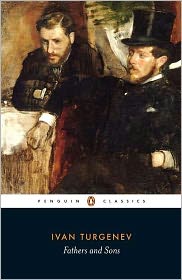
Fathers and Sons by Ivan Turgenev


Rating: 4 Stars
[Translated from the Russian by Rosemary Edmonds]
Ivan Sergeyevich Turgenev (1818-1883) was among the first of 19th. Century Russian writers to win both acclaim in Europe and popularity at home. Fathers and Sons, considered his most successful work by many, was published in 1861, and deals on the social end with the political reforms introduced to Russia at the time. Closer to the heart, it’s about the age-old struggle between the generations to understand another. George Bernard Shaw would seem to have said it right that, “it is all that the young can do to for the old, to shock them and keep them up to date”.
The stormy petrel of the novel, Bazarov, seems to apply that rule anyway. Not that Bazarov looks to jolt anyone; he is merely a practicing ‘nihilist’, a term so outdated today as to appear quaint. As he tells another character,
“In these days the most useful thing we can do is to repudiate – and so we repudiate.”
“Everything?”
“Everything.”

Among the things Bazarov repudiates wholesale are all governmental institutions, philosophy, art, nature, faith, love, marriage, and tender sentiments. In our day, he might well appear to be a candidate for Prozac, but Bazarov is so over-poweringly robust, confident and derisive, that the milder souls around him are set all atwitter with admiration, intrigue or irritation.
Bazarov’s young friend, Arkady looks up to Bazarov as his mentor, and makes patent efforts to adopt an attitude and philosophy that is alien to his own nature. In truth, Arkady is more like his shy, liberal, and music and nature loving father, Nikolai Kirsanov than he wants to admit. Kirsanov is hurt by the growing distance between him and his son, and perceives that Bazarov’s influence over Arkady is responsible for it, but he is too good-natured to hold a grudge against him for that. Arkady’s uncle, Pavel Petrovich, a man who is aristocratic by birth and temperament, bristles at Bazarov’s flippant manner to him, and is less forgiving than Nikolai. Anna Odintsov, a beguiling young widow is attracted to Bazarov, but will brook no threat to her independence and comfortable lifestyle.
Bazarov, who by all rights should be insufferable, is nevertheless a winning character. He has intelligence, integrity, and a sense of humor, and is by no means as invulnerable as he makes himself out to be. Like Arkady, he too is a much-loved son, and there is a pathos and tenderness in the way his elderly parents dance around his every wish, in terror of wearing out his patience with their affection. Neither is Bazarov , though certainly far from being sensitive, completely indifferent to them.
The picture we get of Russia in the second half of the 1800s is of a country in the throes of a dubious reform. The Liberals, Radicals and old land-owners are in deep contention with one another. The serfs, despite their abject poverty, ignorance and disorganization, are already seen as a danger if not an imminent menace. Well, we know how that story played out. ‘Fathers and Sons’ though considered a highly political novel at the time of its publication is now less about political trends and ideologies that wax and wane with the times. Its meaning to us, living in a different age, lies in those values on which Bazarov dispenses his scorn, that yet outlast every generation and live on undyingly into the next.

Sunday, August 28, 2011

The Hottest Dishes of the Tartar Cuisine by Alina Bronsky


Rating: 3 Stars
[Translated from the German by Tim Mohr]
Its saucy title seems designed to lure in readers seeking spice in their reading, or kitchen, or elsewhere, as it may be. Generally, I avoid chick-lit like a leper colony – too much belly-aching from women obsessing about their looks, boyfriend difficulties, and unresolved issues with their mothers. The protagonist of Alina Bronsky’s book, Rosalinda Achmetowna, has no problems with how she looks, thank you very much. In her own modest esteem, her appearance is often the envy of lesser women. She also happens to have her men exactly where she wants them – either wrapped around her little finger, or out of her life. Having no mother, she has no issues with her. Her own daughter, Sulfia, is too intimidated by Rosa to cross her in anything.
Rosa has decided that Sulfia will forever be a disappointment to her. She has such a low opinion of her that when seventeen year old Sulfia tells her she is pregnant, Rosa finds it easier to believe in an immaculate conception, rather than the possibility that a man might have actually impregnated her. She then proceeds to try a number of home remedies to abort the pregnancy, but for once in her life she fails. However, when her grand-daughter Aminat is born, it’s love at first sight. No wonder; Aminat resembles her so much that she seems to be the daughter Rosa would much rather have had. This book is about these three generations of Russian women, and their difficult relationship with each other that steers the course of their lives.
The book begins in the last years of Communist Russia, and later moves to Germany, while making brief visits back home. The mainstay of this book is the characterization. Rosa is a termagant who plows through life like a force of nature. Capable of tackling any crisis, she is one of those terrifying competent types who should be building empires, and demolishing enemy factions. Give her anything less than that, and her natural skills are seriously misused. It’s not that her heart is not in the right place; she is just not someone who will ever look into someone else’s heart, and see the vulnerability and need hidden there.
“…I didn’t have anything against my daughter Sulfia…Helping Sulfia in raising my grandchild didn’t bother me at all. Neither did drawing Sulfia’s attention to her own frequent mistakes. All I ever wanted was for her to improve herself.”
Sulfia is the perfect foil to Rosa. She is everything Rosa isn’t – gentle, timid and soft-hearted. Though she initially seems incapable of looking after herself, let alone anyone else; that is actually the one area in which both she and Rosa excel. They care for everybody who crosses their path, and needs their help. Unlike Rosa though, Sulfia’s caring is selfless. Aminat is caught between these two women – a grandmother who insists on knowing what is best for the whole family, and a mother who is bereft of direction. The book starts out wickedly funny, but the comic flavor dries out halfway through the story. Enjoying it after that  hinges on sympathizing with these three people and their bad judgment calls.
Russian-born author Alina Bronsky's ‘The Hottest Dishes of the Tartar Cuisine’ was nominated for Germany’s book award in 2010. After all, happy homes only result in pleasant childhood memories and well-adjusted adulthood. Dysfunctional families are apparently the way to strike literary gold.

Monday, May 2, 2011

Catherine the Great by Henri Troyat


Rating: 3 & 1/2 Stars

[Translated from the French by Joan Pinkham] 

In one sense, the ongoing ballyhoo about the ‘birther controversy’ is a tribute to democracy, in that; even the legitimacy of a duly elected American President can be challenged by a discontented minority. We’ve come a long way from 1762 when an upstart German princess seized the Russian throne to become one of the most formidable powers of the 18th. Century.

Born Sophie Augusta Fredericka in Prussia in 1729, Catherine the Great became Empress of Russia, through a co-mingling of fortune, chance, and ruthless ambition. Young Sophie sensed herself predestined for greatness, despite the indifference of her mother and the scant attention of her father, who was a minor German princeling. She was a prodigiously intelligent tomboy who set her sights on marrying the crown prince of Russia whom she first met at the age of ten. Sophie’s family began to rise in prominence around the same time Elizabeth I (not to be confused with England’s Virgin Queen) ascended the throne of Russia. Elizabeth I adopted her nephew, and declared him heir apparent. Wishing to contract a suitable alliance for her heir, Grand Duke Peter, she sent a proposal of marriage for Sophie. King Frederick II of Prussia also favored this alliance, hoping it would bring a rapprochement between the two countries.

Once in Russia, Sophie ingratiated herself into the Queen’s favor. Pleasing Czarina Elizabeth could have been no easy task. The Queen was a mercurial and unpredictable woman, who swung between extremes of generosity and cruelty, piety and licentiousness, ruling her court with her tyrannical whims. But she was sufficiently impressed with Sophie, who assumed the name Catherine on converting to the Orthodox faith, before she married Peter. The eighteen-year old Grand Duke seems to have been more boy than man, his physical development having been retarded by childhood ailments. He spent his wedding night playing with his toy soldiers. 

The marriage had been unconsummated for eight years when Catherine met Serge Saltykov, a man with a taste for danger and lonely Grand Duchesses. Catherine became pregnant with his child. Despite his fondness for playing with matches, Saltykov knew all too well the dangers of setting a virgin forest on fire. He persuaded G.D. Peter to submit to a surgical procedure which corrected his little problem, and conveniently gave a probable cause for any child borne by Catherine. Catherine’s first and second pregnancies ended in miscarriages. Historians are still unsure as to the paternity of Catherine’s son, Paul Petrovich.

Once Czarina Elizabeth died in 1761, the reign of Peter III was short-lived. Catherine soon deposed him to become the absolute ruler of Russia. Nor did the aristocracy or the people mind so much. Peter III’s eccentricities – his hatred of Russia, his public clowning around at Elizabeth’s funeral, the unthinkable concessions to Prussia once he had ascended the throne - did not endear him to the general populace. That he didn’t seem to see the incongruity of the sovereign of Russia behaving like a subject of Prussia smacks of imbecility at best, or high treason at worst. Catherine, who had assiduously applied herself to learning Russian, and had ardently embraced her new country stood in favorable contrast. She said to her physicians,

“Bleed me to my last drop of German blood so that I may have only Russian blood in my veins.”

She ruled her country with an iron hand for thirty-five years.

It’s said that power corrupts, and absolute power corrupts absolutely. The intelligent, liberal-minded young queen gave way over the years to an entrenched autocrat who realized that the landed nobility was her power base, and that they must be appeased at all costs. The ‘costs’ were the disenfranchised serfs who formed the majority of Russia. Consider that the standard pension for one of Catherine’s ex-lovers included an average of five thousand serfs, give or take a couple of thousand. However, her human rights record aside, by the end of her reign, Russia’s territories had expanded, education was promoted, women’s rights were furthered, the small-pox vaccine was introduced, and religious tolerance was enforced. That is to say, as tyrannical despots go, she was not too bad.