Showing posts with label Essay Forth. Show all posts

Thursday, December 1, 2011

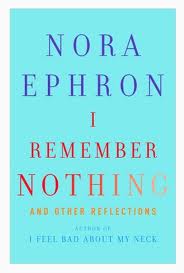
I Remember Nothing by Nora Ephron


Book Club January 2012 Pick
At first glance, Nora Ephron would seem to be one of those people who are born to write.  Author, director, and producer, she is the daughter of screenwriters; sister to three siblings, all writers; and, incidentally, the men she married happened to be writers as well.
Her latest book, ‘I Remember Nothing’ is a compilation of essays ruminating on various topics – her career, family, divorce, growing old. Essays may not be an accurate term here, since quite a few 'chapters' are Lists of 25 Reasons, and many of those reasons are simply reworded versions of the same idea. When a writer happens to be a Hollywood personality, I guess they can get away with a lot more than those who do it to pay the bills.
The book is also a casualty of that other illusion cherished by celebrity authors – namely, that every stray thought that meanders through their mind is worth sharing. The essay form does offer an opportunity to vent one’s grievances, and Ephron doesn’t hesitate to take advantage of it. Among those she’s peeved at – her departed mother; one of her three sisters; at least one of two ex-spouses (Carl Bernstein, journalist of ‘Watergate’ fame); people who were formerly her friends; people who are currently her friends but are not favorably impressed with her dessert-making abilities; migrating geese…the list goes on.
Humorists unabashedly mine their family and acquaintances as potential sources of bandinage, and that’s quite acceptable. But bitterness or self-pity can ruin that effect. It would be wise for a successful, famous woman to avoid sounding petty-minded, or, speaking ill of the dead.
There were parts of the book that I enjoyed. Ephron’s three screenwriting nominations are believable; she can write. Though I wish her choice of subject matter had been different, it was not an onerous task to read her book, meaning, it was not boring. Her essay about her induction to journalism captures the giddy exhilaration of a young woman finding her raison d’etre. Her take on divorce was both poignant and honest, and left me feeling more than a little sympathy for her. Her humor can take a wry, self-deprecating turn; she could have perhaps used that more. It’s no great challenge to wield a pen to show other people in a bad light; there's a greater subtlety to laughing at ourselves. We may as well; after all, others are probably already doing it.


Tuesday, November 29, 2011

Pulphead by John Jeremiah Sullivan


Rating: 3 Stars
‘Pulphead’, the second book from John Jeremiah Sullivan, is a collection of essays that range from philosophical musings to whimsical vignettes of Americana.
Sullivan has been a contributing writer to many major American magazines, and I’m guessing his beat was the music scene, since nearly half the essays have to do with music in one form or another – Christian Rock, MTV reality shows, or bios of well-known artistes. When talking about music, he invests his subjects with both passion and erudition. His article on Bunny Livingstone stoked my curiosity and led me on a virtual scavenger hunt for those names and events in history that have hitherto left my interest untouched. In his bio on the late Michael Jackson, he explores both his phenomenal talent and the troubling rumors of his later life. Personally, that piece confirmed what I’ve long secretly suspected – M.J. was a god of music.
In his essays on the chaos following Hurricane Katrina, or the tea-party movement, he combines clear-eyed observations with a wry humor. I was especially entertained by an enlightening glimpse into Benjamin Franklin’s views on universal health care. The only piece that struck an odd note was the catchily titled ‘Violence of the Lambs’, which is a little too amusing to be taken seriously. He stops a tad short of predicting a ‘planet of the apes’ situation as a possible future scenario.
With his eclectic choice of themes, Sullivan throws light on many obscure topics, and renders them fascinating to the extent that one wonders how they could have been obscure for so long.

Thursday, July 7, 2011

Manhood for Amateurs by Michael Chabon


Rating: 3 Stars

In some ways, Chabon’s essays are the antithesis of the qualities lauded in Rudyard Kipling’s celebrated poem on manhood – ‘If’. Man, not as a compendium of noble ideals, but rather as an occasional loser, screw-up, and jerk. It should probably be added that Chabon's mostly talking of himself rather than anyone else.

At his best, as in ‘Getting Out’, his writing is lucid, sensitive and subtle. In others, he simply misses the mark, rambling aimlessly, taking the reader on a trip that has us whining, ‘Are we there yet?’ One or two come off as rants, as in ‘The Splendors of Crap’. Sure, the entertainment peddled to our kids is often inane, treacly, or deplorable. But here’s the thing - the kids lap up this sludge. If parents want to influence their children's tastes, that’s best achieved by getting involved and staying actively engaged in their recreational pursuits.

Chabon also riffs with varying degrees of persuasion on other time-honored ‘manly’ isues – carpentry involving power tools, brotherly bonds, baseball, comics, and science fiction T.V. shows. There are a couple where he self-consciously sets himself apart from the rest of his tribe, as in his stated indifference to public opinion when it comes to carrying a 'man-purse', his protest at gender-assigned colors, and his pride in his cooking abilities. Here again, America is a step behind the rest of the world. As I see it, men the world over do not feel their masculinity challenged merely by wearing pink or violet, having a handy tote, or at feeling at home in the kitchen.

Having weathered a difficult and fractured childhood, Chabon seems to bear commendably little hostility towards his own parents. He doesn’t seem to hold it against them that they divorced; split siblings apart; either faded away from his life; or, busied themselves in pursuing the lifestyles of the Groovy 60’s and Swinging 70’s.

Books are meant to be critiqued; courtesy and self-doubt should restrain us from doing the same to the parenting techniques of other adults. Except of course, in those cases, where said parents hang placards with concentric red circles around their necks and invite us to try our marksmanship, as in perhaps, writing a book about their child-management. One interesting example was the conversation that Chabon has with his four children, ranging in ages from 13 to 4, about drug use. He seems to have spent more time agonizing over the decision to circumcise his sons. 

Having chosen earlier with his wife to be completely honest and transparent about their own pharmaceutical experiments, he then proceeds to inform the kids about the enticements of getting high on marijuana, and concludes by informing them that that’s not something they’re ‘ready to do.’ How much honesty can children handle? Are their needs served better by a full confessional, or do we hold back on the whole troubling truth, respecting their innocence and (sometimes wholly unfounded) trust in the better judgment of their parents? Fools rush in where angels fear to tread.

Thursday, April 14, 2011

At The Fights: American Writers on Boxing edited by George Kimball & John Schulian

Rating: 3 & 1/2  Stars


“It is the easiest thing in the world to say that professional boxing ought to be banned because it is savage, corrupt, and a dangerous health threat to the men who participate in it. Yet this moralistic rage of the righteous misses a few major points: First, to ban boxing would not prevent the creation of boxers since that process, that world would remain intact. And what are we to do with these men who know how to do nothing but fight? I suppose we can continue to lock them in our jails and in our ghettos, out of our sight and untouched by our regard. That, in the end, is precisely what those wishing to ban boxing really want to do…Second, those who wish to ban boxing know that they will simply condemn those men to surer deaths by not legally recognizing the sport. Boxing banned will simply become…a very popular, underground, totally unregulated sport.” – Gerald Early from ‘Ringworld’

‘At the Fights’ has done what I would have considered impossible – made me feel uncouth and graceless for never having cultivated an interest in the ‘sweet science’ of boxing. As the title indicates, the book is an anthology of some of the finest essays on prize-fighting. Whether the reader is an ardent fan of the sport, or has only lukewarm or non-existent interest, the writing in this book packs a wallop, then amiably steers us into a ringside seat where we breathlessly watch the drama unfold before our eyes. 

Like the sport it portrays, the writing too is stylish, savage, and visceral. One fine example of a match description is Irvins S. Cobb’s coverage of the 1921 Jack Dempsey-Georges Carpentier fight.  It has a careless savoir-faire and panache in capturing the feverish excitement in the arena, and delivers an actual blow-by-blow account of the scene, so that it seems to be playing out before us in cinematic slow-mo. On the same fight, H.L. Mencken has some trenchant remarks to make in the trademark style that made him an American literary icon.

Not all the essays are press reports of matches. Many of them are about the boxers themselves. These intimate portraits are instrumental in dispelling the stereotype of the fighter as a low-browed Neanderthal dragging his knuckles on the ground. More often than not, it shows the boxer, not as a vicious bully (not always anyway), but first and foremost, an athlete who has chosen to make his living through his strength, his more-than-average killer instinct, and, his ability to take a beatin’ and keep on poundin’. It’s almost a universal rule, that these boxers come from working-class backgrounds, from tough neighborhoods, where they learned early to hone their aggression, and unleash it on a target. And yet, some of them like Dick Tiger and George Foreman, overcame their early disadvantages. Some like Stanley Ketchel and Al (Bummy) Davis succumbed to a predictable end.

It takes more than pro-boxers to make the fighting world. Also included is some memorable portraiture of amateurs, trainers, promoters like the colorful, and notorious Don King; and, some scathing indictments of the corruption in this sport, which probably would have been there even if the Mob hadn’t muscled in on the action. Let’s face it – with the exception of the factory farming of teen-aged pop tarts, this is the most exploitative industry in the world.

This is a fascinating book, though a couple of essays stick out by their mediocrity, and from some surprising sources. Norman Mailer’s ‘The Fight’ is one example of how not to write non-fiction – turgid prose that gets snowed under by a flurry of needless metaphors.

So, am I ready to join the legions of fans of the pugilistic arts? Hardly. It would take more than a book to undo a lifelong aversion to violence. I have reconsidered all my assumptions about boxers. But what to make of the audience, safely ensconced in their comfortable seats, risking injury to neither life nor limb, yet fearlessly roaring encouragement to one man to beat the brains out of another?


Thursday, September 9, 2010

What the Dog Saw: And Other Adventures by Malcolm Gladwell


Rating: 4 Stars 


A recurrent escapist fantasy for some may be to be marooned on an island paradise with their favorite book. Well, if you give me a Malcolm Gladwell book, you can keep the island paradise.

His latest offering, “What the Dog Saw” is a compilation of essays that he wrote while working as a staff journalist for the ‘New Yorker’. Though each one is a disparate article, the author nevertheless entertains, informs, and enlightens in the inimitable style that rocketed his previous three books to the best-seller lists.

Not everyone may be equally impressed with his choice of subject matter. Some of them seem pretty trivial, but one attraction of this book is the juxtaposition of seemingly unrelated topics, that somehow not only work, but also manage to elucidate one another. A good example is the one where he traces the trajectory of the Feminist movement with the development of the Hair Coloring industry. Or, where he draws points of comparison between predicting the next NFL great, or the next terrific teacher.

As with most of his books, Gladwell’s deep interest in the workings of the mind (human and otherwise) is apparent here as well, whether it’s in the ‘science’ of criminal profilers (he’s too polite to call them charlatans, he leaves that to the reader to infer), or the intuitive body language of the “Dog Whisperer”, Cesar Millan, whose story forms the title of the book. If you’ve ever wondered why some people do better than others at job interviews, and have prospective employers eagerly wooing them; whether early precocity predicates genius; or, if smarts equals success, the author has an insight to offer. Each is an appetizing slice of psychology that surprises with its freshness.

On the subject of Enron, he has a lot to say. One chapter is a dispassionate reworking of that recent debacle with a more equitable apportioning of blame. Another is a scathing indictment of a corporate culture that seems almost mind-bogglingly narcissistic and undisciplined, fawning over talent and potential, at the risk of jettisoning common sense, let alone business acuity.

There are many points on which the reader might wish to argue with the author. Perhaps he’s not too proprietary over his work, but surely intellectual copyright serves its purpose. There are some instances where his solutions are staggeringly simplistic – give the homeless a home. But neither are they easy to dismiss.

Gladwell’s work is part myth-busting - debunking some of our most fondly cherished ideas - and part social commentary. Those who offer social commentary don’t demand that their ideas be executed into action. They simply offer an alternate view, and that is something out of the ordinary in itself. As he succinctly observes,

“…if everybody had to think outside the box, maybe it was the box that needed changing.”