Showing posts with label Science Fiction. Show all posts

Monday, May 30, 2011

Pebble in the Sky by Isaac Asimov


Rating: 3 ½ Stars

In a time not too long ago, before ‘Vulcans’ and ‘Klingons’ became part of common parlance, before space operas with stirring theme music hit the cineplexes, there was Asimov. Author of nearly 500 books, Isaac Asimov (1920-1992) was more than just an amazingly prolific science fiction writer. Perhaps his greatest contribution was in ushering highly specialized knowledge out of the cloisters of academia, and making it accessible to the common man. A lay reader with little or no interest in science would still be able to appreciate and enjoy Asimov’s writing. ‘Pebble in the Sky’, published in 1950, was the first of his many books.

Joseph Schwartz is a sixty-two year old retired tailor. An accident in a nuclear lab creates a time fault that transports Schwartz from Chicago in 1949 to Chica in the Year of the Galactic Era 827. Even with his considerable intelligence, it takes Schwartz a while to realize what’s happened to him. No wonder; the language spoken in Chica is nothing he recognizes, nor is the Planet Earth as he remembers it. Its soil leached by radiation, Earth occupies a dismal position among the 100 million star systems that make up the Galactic Empire. It’s a washed up world, a mere ‘pebble in the sky’, and its denizens are universally despised as inferior beings riddled with contemptible traits.

Not the kind of species to take this disparagement lightly, Earth is in a fighting mood. Despite all the odds stacked against them, earthmen have a couple of tricks up their sleeves. However, they face off not against tentacled or insectoid aliens, but adversaries who appear to be human as well. Therein lies the moral dilemma of the book. Asimov seems to agreeably see both points of view, and doesn’t appear to favor one over the other. Either way destruction lies. The salvation of the galaxy might just rest on the shoulders of a mild-mannered tailor from the Past.

The jury is still out on whether certain books should be categorized as science fiction or fantasy. The one thing we can safely say is that there is no ‘magic’ in science fiction. Everything that requires a plausible explanation is given one, and nothing is attributed to eldritch elements. The frame of this story is bolstered by hard science, and the pace of the plot is enjoyably brisk with a gratifying conclusion. In one slim novel, the writer still manages to raise thought-provoking issues of bigotry, war, and the possibility of an uninhabitable planet.

Monday, April 4, 2011

The War of the Worlds by H.G. Wells


Rating:4 & 1/4 Stars

H.G. Wells’ (1866-1946) predecessor, the French writer, Jules Verne, was a fascinating story-teller. However, by modern standards, his books fall short on the scientific know-how, and technical details, that are so essential in anchoring this genre to the realm of the believable. The War of the Worlds, published in 1898, in its vivid recounting of space travel, mechanical monsters, predatory aliens, a post-apocalyptic Earth, and a plausible explanation for how this all came to be cleared the way for science fiction as we know it today. 

The unnamed Narrator tells us how at the turn of the century, invaders from Mars land on England, intent on conquest and occupation. The reaction of the general populace is rather dampening. As the Narrator wryly remarks,

“So some respectable dodo in the Mauritius might have lorded it in his nest and discussed the arrival of that shipful of pitiless sailors in want of animal food. ‘We will peck them to death tomorrow, my dear.’”

This phlegmatic response doesn’t last long. Once more of the Martian cylinders start bombarding the earth, and the tripods begin strafing the earthlings with their laser guns, people start panicking in the oldest traditions of humanity – rioting, looting, and scrambling for safety. Wells was perhaps not a big believer in the heroic potential of men. Depending on your perspective, the story’s conclusion might be seen as either ironic or anti-climactic. 

Written as it was at the tail-end of the nineteenth century, this is one classic where the language is accessible. Wells had an ear for the common accent, which somehow makes the story more probable than a cast of characters stiffly enunciating the Queen’s English. There is a chilling lack of sentiment to the narration. The breakdown of law and order is described in a methodical manner; and when the Narrator meets with the artilleryman, the latter’s prognosis for the future of mankind is as bleak as it is utterly logical.

Wells treatment of the topic isn’t to cow his audience with shock and awe. He gradually ratchets up the tension, and trusts the reader to allow his imagination to fill in the gaps. If only more modern authors would emulate that technique.

Tuesday, December 21, 2010

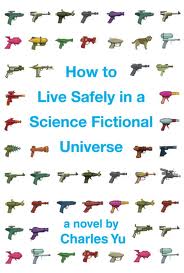
How to Live Safely in a Science Fictional Universe by Charles Yu


Rating: 3 and ½ Stars


“Time is a machine: it will convert your pain into experience. Raw data will be compiled, will be translated into a more comprehensible language. The individual events of your life will be transmuted into another substance called memory and in the mechanism something will be lost and you will never be able to reverse it, you will never again have the original moment back in its uncategorized, preprocessed state. It will force you to move on and you will not have a choice in the matter.”

-       -   How to Live Safely in a Science Fictional Universe

At the beginning of Charles Yu’s book, there is an inverted Zen to the protagonist’s concept of Time Travel. Instead of living in the Eternal Present, he is hiding in the ‘Present Infinite’.

Wandering into this author’s mind is a trippy experience. The first few chapters left me wondering what rabbit hole I had fallen into. But once he stops being head-spinningly clever, it’s easier to appreciate a book that is deeply insightful, while still managing to be both funny and sad, very often all three at the same time. Yu’s novel is a philosophical one at the core. His hero is a solipsist who ruefully sees that the most intense love-affair he will have is with himself. Not only is he his own lover, he is also his own friend, foe, and mentor.

The hero of our novel, also called Charles Yu, is a time-traveling trouble shooter in a science fictional world – Minor Universe 31. He junkets around in the TM31 with his dog, Ed, and TAMMY, the computer operating system that he has a crush on. He is in a service profession, where his main job is to extricate people who bumble out of the Present, mostly trying to redo some point in their past. 

Yu understands that the whole point of time-travel is to transform our lives by rectifying past errors and forestalling future calamities. Ironically, this is not possible because it would warp the thin fabric of reality. The time travelers face the prospect of yo-yoing between Past, Present and Future time zones without making the slightest dint of impact in their pre-destined lives.

Perhaps the most inventive thing about this book is Yu’s writing. Both Science and Language are expressions of thought, and he expresses himself in a bright, sparkling style. It is not however entirely free from flaws. He tends to use rather more words than strictly necessary, and meaning occasionally founders under a miasma of technical jargon.

His greatest strength is his understanding of the delicate, tenuous nature of human relationships, and the intimate dynamics of family life. In his book, Time is not the span separating Present from Past or Future. It is the distance between our dreams and disappointments, love and longing, hope and regret.